For NYK FansOur Challenges

When you choose the dark mode display, you can reduce the power consumption and CO2 emissions generated by the website's screen display.
Released : Jun. 05, 2026
Updated : Jun. 05, 2026


In April 2026, NYK will further evolve its original safety standards, “NAV9000.” Introduced in 1998 with the aspiration of ensuring a shared level of safety across all operating vessels, not just the company’s owned vessels but charters as well, these safety standards have supported NYK’s safe navigation for more than a quarter century. This initiative has never been an effort by NYK alone. Together with partners including ship owners and ship-management companies, the company has consistently addressed safety, the foundation of shipping company management. This initiative, renewed as “NAV9000 Plus,” aims to achieve a higher level of safety through the spirit of guidance and co-creation. Under the philosophy of “Without safety, there is no trust; without trust, there is no business,” NYK will deepen collaboration with all stakeholders while pursuing both safety and quality.
“NAV9000,” the original safety standards applied to vessels operated by the NYK Group, as well as to shipowners and ship-management companies, were introduced with the objective of enabling NYK to fulfill its responsibilities as an operator for safe navigation and environmental protection. In the late 1990s, the prevailing view in the maritime industry was that the primary responsibility for safety management lay with shipowners and ship-management companies. However, from shippers’ perspective, NYK believed that regardless of vessel ownership and management structure, the company itself as an operator should be the party directly responsible for achieving safe navigation. “NAV9000” clearly demonstrated that commitment.
The introduction of “NAV9000” coincided with the period when the International Safety Management Code (ISM Code) entered into force based on the International Convention for the Safety of Life at Sea (SOLAS) of the International Maritime Organization (IMO). Managing Executive Officer Hisaya Higuchi, who is in charge of the Marine Group, reflects, “The Safety Management Systems (SMS) established by ship-management companies in accordance with the ISM Code represented the minimum framework necessary to ensure safe navigation and marine environmental protection. Our starting point was to create a standard that also incorporated the requirements of NYK and of charterers.”
The history of “NAV9000” can be seen as the pioneering of quality assurance within the maritime industry. The name “NAV9000” reflects the philosophy of the international quality management standard “ISO 9000,” which has been incorporated into the ISM Code. Safety and quality improvement activities conducted under “NAV9000” have been certified under the international quality management system standard “ISO 9001:2015” by Nippon Kaiji Kyokai (ClassNK).
“NAV9000” consists of three major elements. The first element consists of requirements based on the four major international conventions related to international shipping (*). The second element consists of the proprietary requirements of NYK, such as measures to prevent the recurrence of accidents and good practices cultivated through experience. The third element consists of industry requirements, which are driven by charterers.
These requirements are clearly documented, and shipowners and ship-management companies are required to implement them. Among the requirements that NYK has implemented as original standards, over time, some have become standard requirements across the maritime industry.
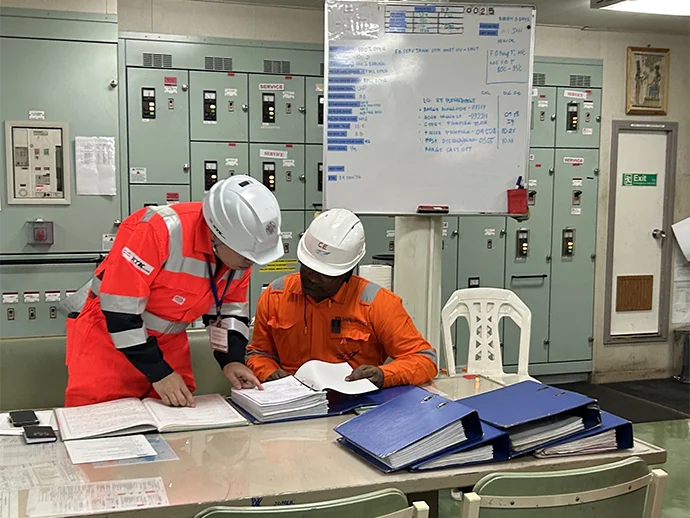
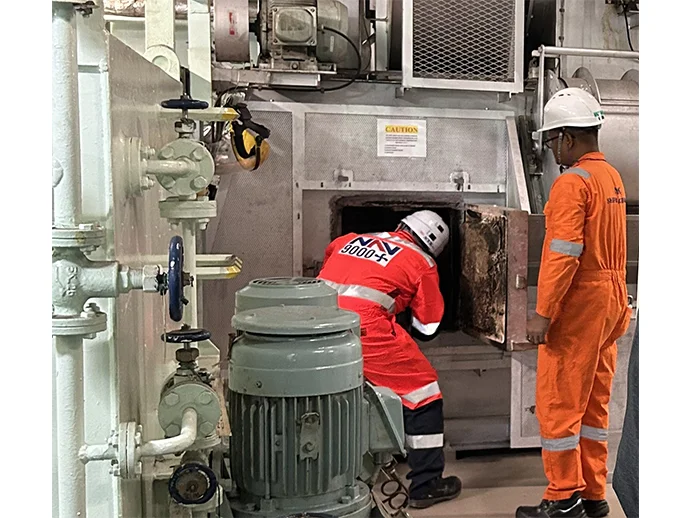
Compliance with the requirements is verified through the “NAV9000 Assessment,” a framework for evaluating vessels and ship-management companies. The checklist consists of approximately 1,500 items, and its scope covers around 800 vessels operated by the NYK Group as well as roughly 80 shipowners and ship-management companies that own or manage those vessels. On an annual basis, assessments are conducted for approximately 200 vessels and about 20 companies. All targets are covered during a several-year cycle, which is repeated continuously. All vessels are evaluated using the same indicators, regardless of whether they are owned vessels, flag of convenience (FOC) vessels, or chartered vessels.
Vessel assessments are conducted primarily by Indian and Filipino Master and Chief Engineer and are carried out over the course of a day at ports of call in Japan, South Korea, China, and Southeast Asia. Company assessments, which are conducted over two days, are mainly handled by Japanese Masters and Chief Engineers, and in recent years, Indian and Filipino Masters and Chief Engineers have accompanied them in order to gain experience.
Evaluations are conducted on a five-point scale, ranging from the highest rating of “5” to “1,” which indicates an extremely high likelihood of accidents or delays. Even when a low rating is assigned, chartering is not immediately suspended; instead, improvement activities are supported. This approach reflects the framework’s philosophy, which places “dialogue” at its core.
Based on the assessment results, shipowners and ship-management companies have implemented the necessary improvement measures, which have led to the steady accumulation of improvements in safety and quality. Regarding these outcomes, Michio Suzuki, Captain, manager of Marine Group’s Global Maritime Quality Assurance Team, states, “Dialogue-based assessments make a significant contribution to raising the level for safety quality.”
Assessment effectiveness is further supported by objective data. In 2024, the average downtime across the entire fleet (the time during which operations were suspended due to accidents or trouble) was 23.2 hours. However, when limited to the 182 vessels for which assessments were conducted in the previous year, the average downtime was 9.5 hours, achieving the target of “within 10 hours.” Moreover, among the 152 vessels with high evaluation scores of 3.0 or higher, the average downtime was 6.4 hours, while vessels with scores of 2.9 or lower recorded an average of 25.2 hours, a clear difference. Regular assessments help to maintain safety standards.
* The International Convention for the Safety of Life at Sea (SOLAS), the International Convention for the Prevention of Pollution from Ships (MARPOL), the International Convention on Standards of Training, Certification and Watchkeeping for Seafarers (STCW), and the Maritime Labour Convention (MLC).

NAV9000Plus logo
NAV9000 Plus assessment
Nearly thirty years have passed since the introduction of “NAV9000,” and during this time, international regulations and industry safety standards have become more stringent. Vessels and ship-management companies have also been subject to various external audits in addition to “NAV9000,” and there has been a growing sense that attention is shifting toward external audits that directly relate to shippers, such as those conducted by the Oil Companies International Marine Forum (OCIMF), which is composed of major oil companies, and vessel inspections conducted by RightShip, a ship rating company that is supported by major resource companies. Suzuki explains, “There was also an increased burden on crews and ship-management companies caused by overlapping audits and assessments. Rather than repeating the same checks, we wanted to clearly define what made ‘NAV9000’ unique and renew it in a way that would enhance its value.” To further improve safety quality and to reliably fulfill the company’s responsibilities as an operator, it was determined that a safety standard that ensured a more advanced safety management framework and greater effectiveness was required.
In this way, the evolved version called “NAV9000 Plus” was formulated. While inheriting the fundamental philosophy and framework, “NAV9000 Plus” places greater emphasis on “guidance,” “co-creation,” and “dialogue,” and aims to further enhance the safety quality of operating vessels through attentive follow-up with vessels, shipowners, ship-management companies, and other related parties.
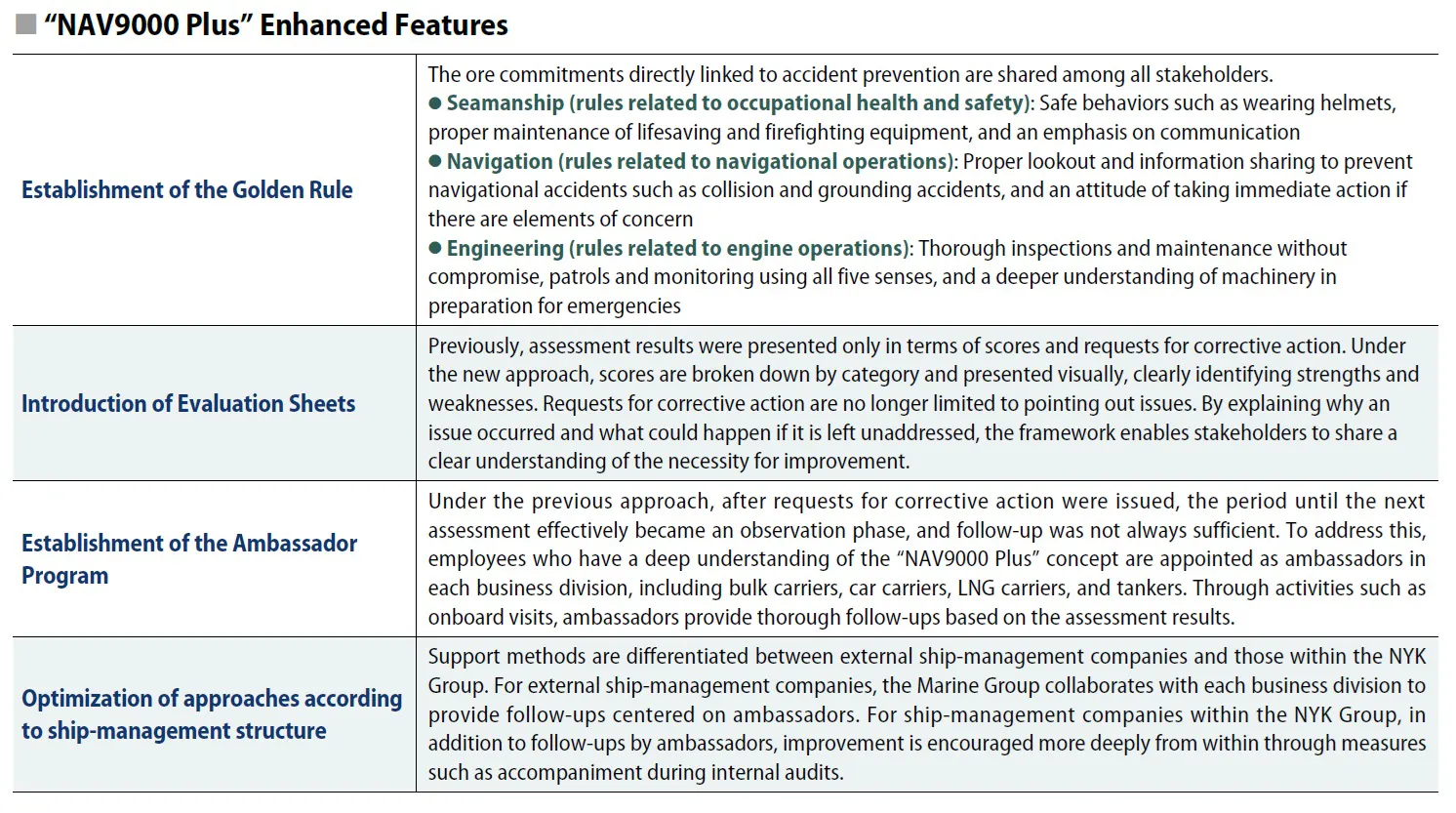
There are four major enhancements regarding the evolution of “NAV9000 Plus.”
The first is the establishment of the “Golden Rule,” which clearly defines non-negotiable safety values.
Chief Officer Shun Hamazaki, Global Maritime Quality Assurance Team, explains, “From the extensive requirements, which amount to approximately 1,500 items when compiled into a checklist, we identified those elements that NYK absolutely cannot compromise on in order to achieve our safety goals of limiting downtime to within 10 hours and achieving zero serious accidents.”
The second enhancement is the introduction of evaluation sheets that clearly present assessment results. The third is the establishment of a comprehensive follow-up framework provided by “ambassadors” who are assigned to each vessel-type business division. The fourth is the optimization of approaches according to ship-management structure. A wide range of measures to enhance effectiveness have been incorporated.
In operating “NAV9000 Plus,” NYK emphasizes that “the main players are the crew and the ship-management companies.” NYK positions itself as a guide that stays close to those on the front lines who are striving to move forward and confront challenges together. For this reason, even greater emphasis is placed on “dialogue” in operations. Rather than merely identifying deficiencies through vessel and company assessments, the company presents concrete prescriptions for improvement and conducts regular follow-ups. Higuchi states, “By working together and playing a role like that of a family doctor to enhance quality, we support and co-create so that each company and each vessel can appropriately respond to shippers’ requirements.”
In addition, some requirements will be revised. Since the most recent revision in 2017, there has been an increase in the number of initiatives led by shippers, including “DryBMS,” an evaluation framework for ship-management companies established by the dry bulk industry. In response, measures that had previously been positioned as recommendations will be added to the formal requirements. By incorporating various requirements from shippers, the aim is to create a framework that ensures compliance with “NAV9000 Plus” will enable vessels to clear the majority of inspections conducted by shippers, as well as inspections conducted by port states, including port state control (PSC).
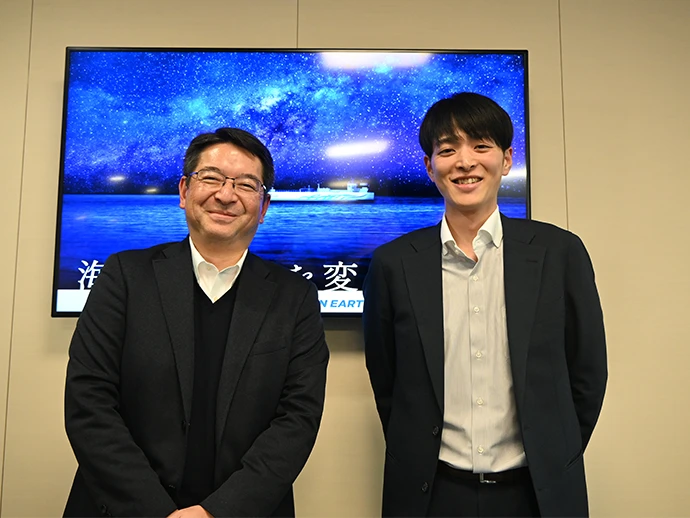
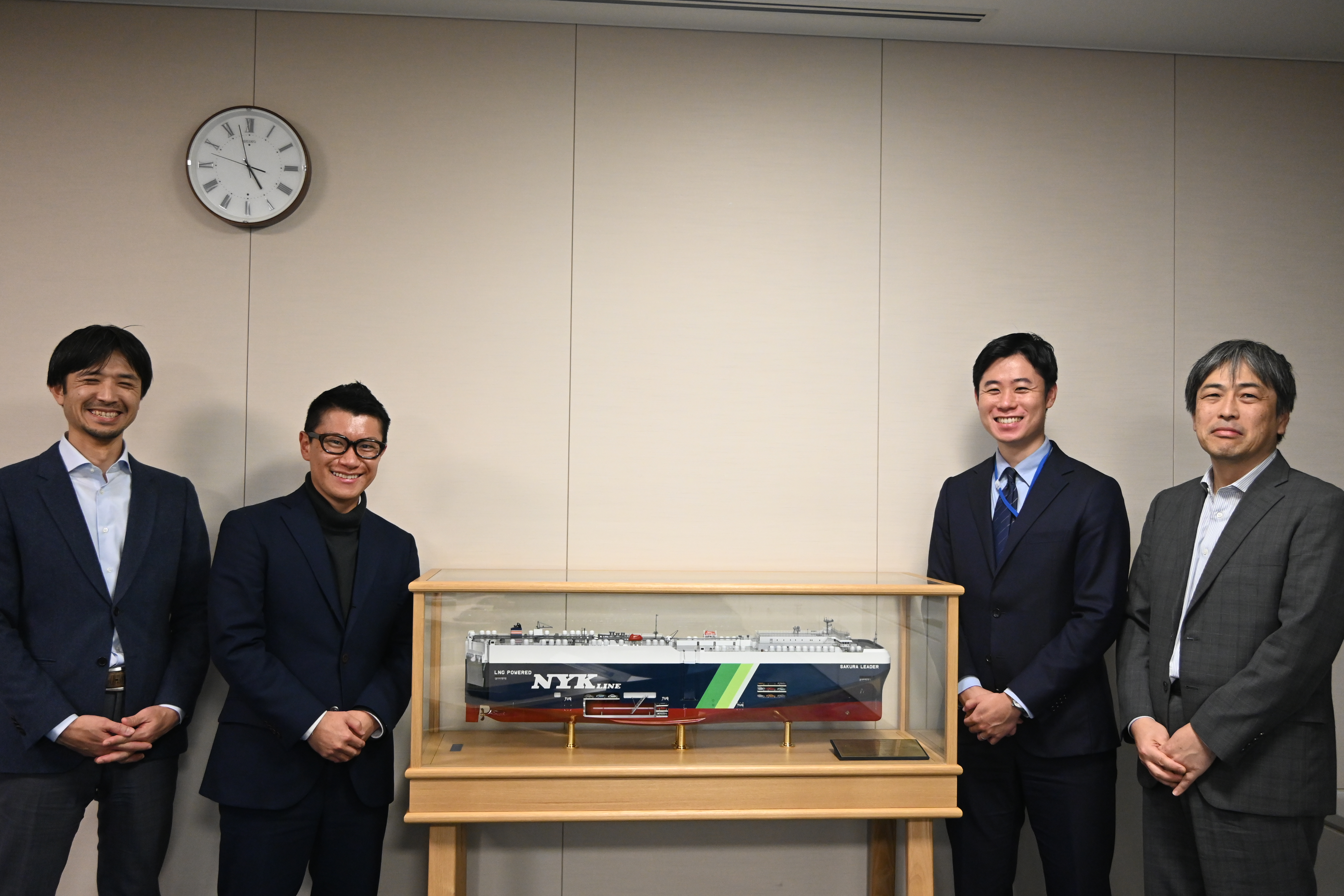
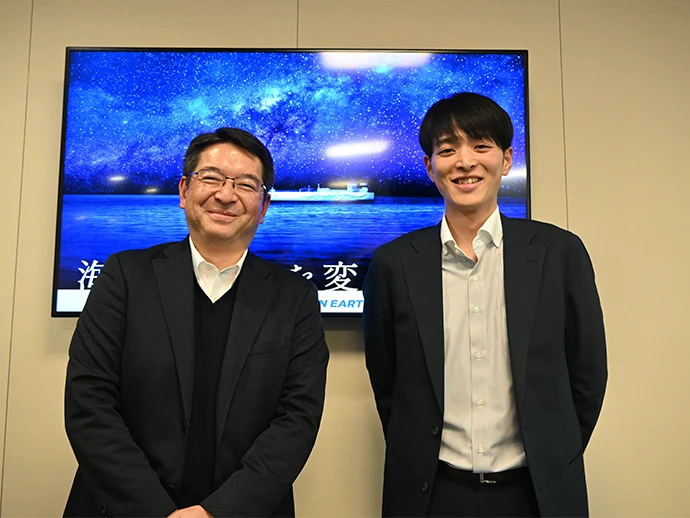
Michio Suzuki (left) and Shun Hamazaki (right)
–– What inspired you to pursue a maritime career, and what roles have you held at NYK?
Suzuki: I originally aspired to become an airplane pilot, but my eyesight did not meet the requirements, so I decided to enter the maritime field. I enrolled at Tokyo University of Mercantile Marine (now Tokyo University of Marine Science and Technology), and by a turn of fate, joined NYK in 2001. During my onboard assignments, I mainly served on LNG carriers and also worked on heavy-lift vessels. From my sixth year with the company onward, I alternated between onboard and shorebased assignments. On shore, I gained experience in Quality Assurance work at an LNG carrier ship-management company and in crewing work at a ship-management company in Singapore. I was also involved in examining business models during the establishment of MarCoPay Inc. Later, amid the unprecedented circumstances of the COVID-19 pandemic, I served for the first time as a Master on an LNG carrier, and I am now assigned to the Marine Group.
Hamazaki: I joined the company in 2017 and now serve as a chief officer. I began aspiring to a career at sea after enrolling at Tokyo University of Marine Science and Technology. I initially chose that university because I wanted to study in Tokyo, but through onboard training, I became fascinated with seafaring work. During my onboard assignments, I have served on a wide range of vessel types, including car carriers, containerships, bulk carriers, LNG carriers, and LPG carriers. In June 2023, I began my first land-based role, and I am
now engaged in safety promotion activities, including work related to “NAV9000.” Before joining the company, I had some concerns about extended periods at sea, but once I actually went aboard, I found it enjoyable and time flew by. Now, while working onshore, I am surprised to find myself wanting to return to sea.
–– What does the “NAV9000 Plus” project mean to you personally?
Suzuki: Nearly thirty years have passed since “NAV9000” was established, and 2025 was also a milestone year marking NYK’s 140th anniversary. I feel a sense of destiny in being involved in this renewal at such a timing. On my first voyage, the captain handed me the “NAV9000” checklist and told me, “Study this,” thoroughly instilling in me the importance of safety quality. Later, I also had opportunities to engage in safety management work at an LNG carrier ship-management company, and all of these experiences connect directly to what I am doing today. Because this renewal represents a major milestone, I am determined to make it a success. The practical work of the project is being led mainly by younger personnel, and I want to ensure that this framework is firmly passed down to the generations that will lead NYK in the future.
Hamazaki: This project’s appeal lies in being able to consider how “NAV9000,” which has underpinned safety quality at NYK, should evolve over the next ten, twenty, and thirty years. We have reviewed materials from when the standard was established in 1998 and, drawing hints from them, are deepening the initiative by incorporating contemporary perspectives. This is truly an example of learning from the past to develop new insights, and I am approaching this project with a strong sense of responsibility.
–– What is your message to those who want to become navigation officers and engineers at NYK?
Hamazaki: At sea, you will serve on a variety of vessel types and experience different ranks. Even on shore, the knowledge and skills required differ greatly depending on the work involved. Continuous self-improvement is therefore essential, but the opportunity to constantly engage in work that is fresh and stimulating is very attractive. I hope people who are interested in the world of international seafaring choose to aim for a career at NYK.
Suzuki: I feel that NYK offers an open and flexible working environment, and I have a deep sense of fulfillment as a seafarer. I experienced the Great East Japan Earthquake while serving as a junior chief officer on an LNG carrier. After the disaster, amid the tight power supply conditions, I was involved in LNG transportation as a chief officer and strongly felt how we were supporting social infrastructure. During the COVID-19 pandemic, I served as a Master on an LNG carrier and engaged in transportation to meet customer needs amid the rising electricity demand associated with an increase in the number of people staying at home. Through these experiences, I came to feel that I was playing a part in supporting people’s daily lives. Transportation work is directly connected to society and how people live. I believe that following the path of navigation officers and engineers allow one to take pride in such a contribution.
Reedited from the KAIJI PRESS Special Issue published on March 31, 2026