For NYK FansOur Challenges

When you choose the dark mode display, you can reduce the power consumption and CO2 emissions generated by the website's screen display.
Released : Jun. 03, 2026
Updated : Jun. 03, 2026


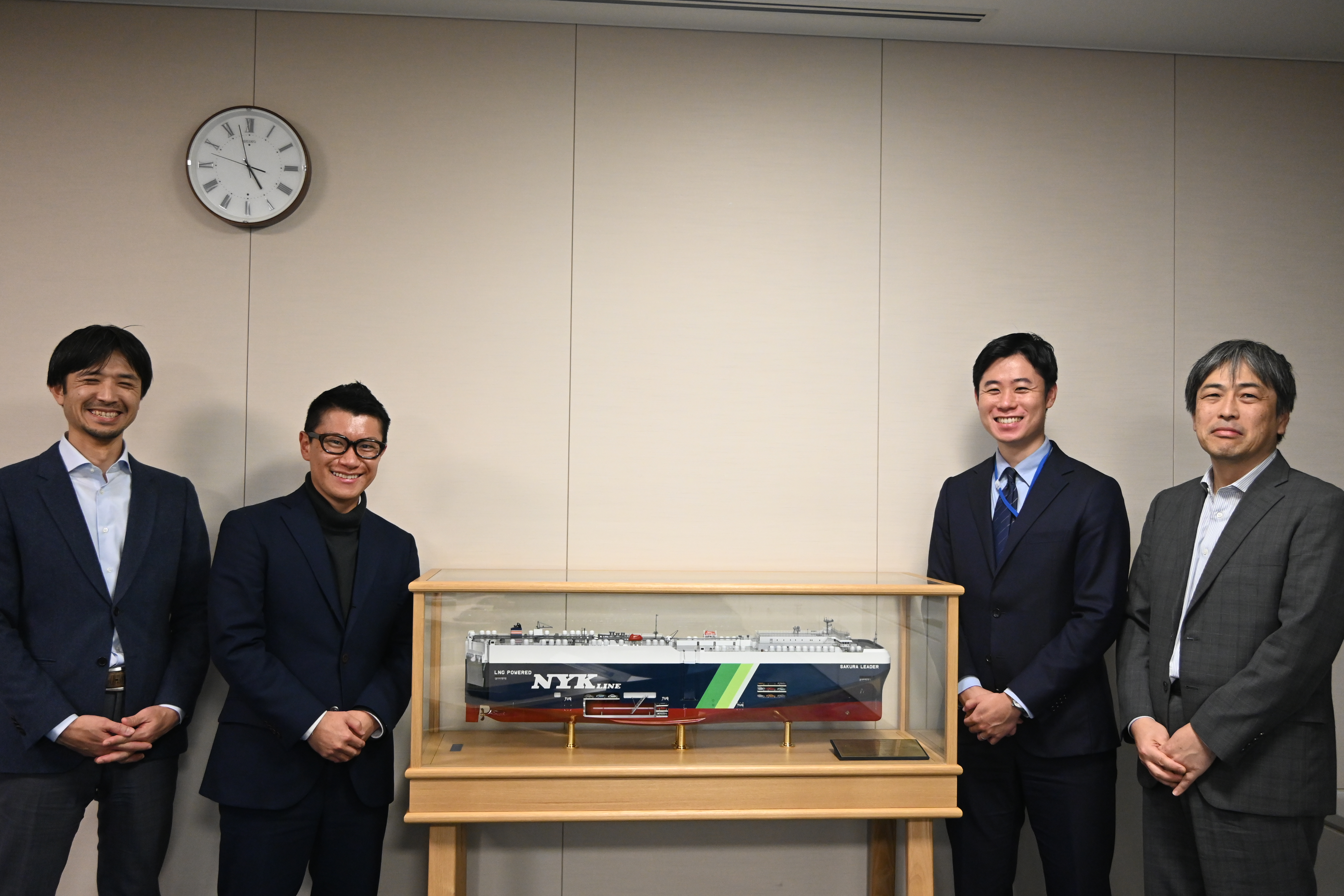
From left: Hiroyuki Nozaki (DX&BPM Team) and Naoki Motohashi (Coordination Team), Automotive Business Management Group, NYK; Narihiro Mitsushima (Researcher, Ship System Team) and Yoshihiko Maeda (Deputy General Manager), Maritime & Logistics Technology Group, MTI.
NYK, together with its group company MTI Co., Ltd., has jointly developed and introduced a system that automates and optimizes vessel allocation planning for car carriers in collaboration with GRID Inc. (Minato-ku, Tokyo; CEO: Masaru Sogabe), a provider of planning optimization solutions that utilize AI technology. Full-scale operation of the system began in July 2025. The system uses AI to evaluate several million possible combinations of vessel allocation plans covering several months ahead and to derive optimal solutions in approximately 10 minutes. In addition to optimizing vessel utilization, transportation efficiency, and transportation costs, the system is expected to help reduce greenhouse gas (GHG) emissions.
Vessel allocation planning for car carriers is a critically important task that determines from which loading ports to which discharge ports, when, by which vessels, and in what volumes cargo is to be transported. After sales representatives ascertain inventory levels and request delivery dates at each customer location and organize transportation requirements, they formulate plans aimed at minimizing costs or maximizing profits while considering a wide range of constraints, including vessel transport capacity, port arrival and departure schedules, cargo handling schedules, dry-docking, bunkering, and charter contracts. In recent years, factors such as sailing at optimal speeds to reduce GHG emissions have been added, further increasing the complexity of vessel allocation planning. In addition, plans must be reviewed and adjusted on an ongoing basis to address sailing delays, operational issues, and changes in cargo schedules.
NYK operates about 120 car carriers globally, the largest fleet in the world, and has conventionally relied on a limited number of highly experienced personnel to prepare vessel allocation plans that cover several hundred voyages months in advance. Due to the nature of this work, the vessel allocation planning process has been highly dependent on individual expertise, making efficiency improvements and knowledge transfer significant challenges.
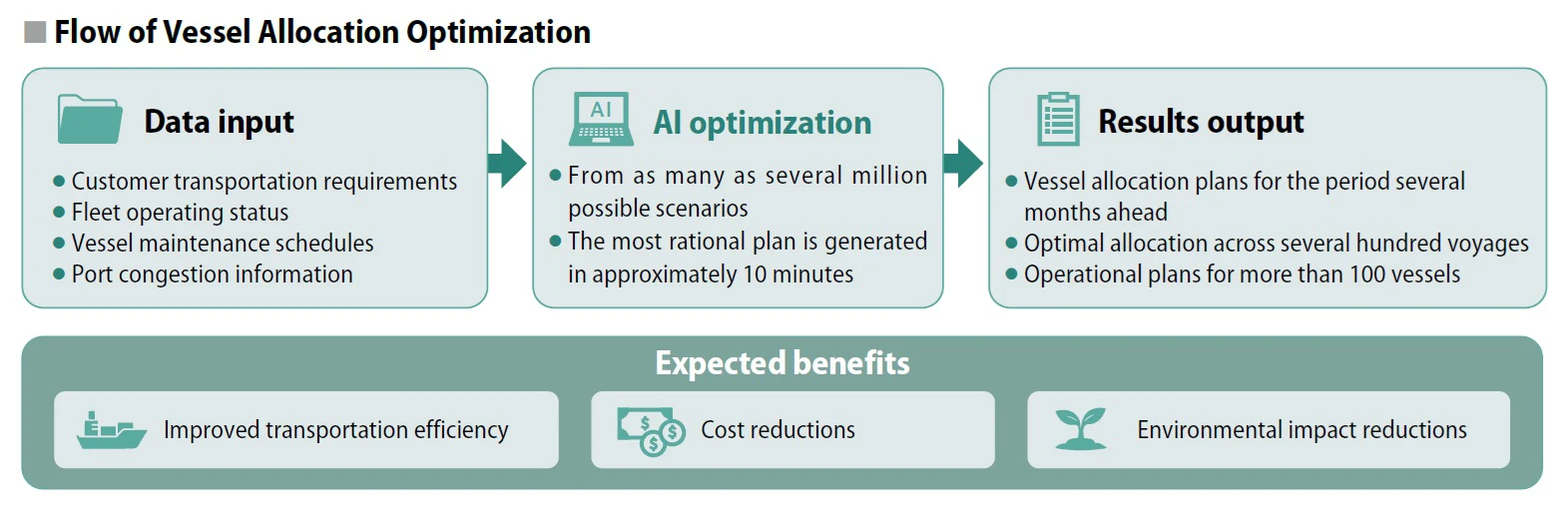
Against this backdrop, NYK began developing an AI-based vessel allocation system in 2021 to organize and structure the information and decision-making factors involved in car carrier allocation operations, thereby improving planning accuracy and efficiency. The project involved vessel allocation planners,the DX·BPM Team from the Automotive Business Management Group, and engineers from MTI with expertise in mathematical optimization. GRID was selected as the system development partner from among multiple candidates. Hiroyuki Nozaki of the DX·BPM Team recalls the reason for deciding to move forward with development with GRID, saying, “What proved decisive was their attitude of not merely promoting their own systems or technologies, but of sincerely engaging with and seeking to understand our business operations and the challenges that we face. Throughout the actual development process, they responded flexibly, proactively, and sincerely.”
Deputy General Manager Yoshihiko Maeda, Maritime & Logistics Technology Group, MTI, emphasizes that “In developing the system, it was significant that the DX·BPM Team first carefully organized and structured the decision-making factors involved in vessel allocation operations.” He continues, “While AI’s computational capabilities tend to draw attention, what is fundamentally important is that there is a process of collecting high-quality data from within the company and that the mechanism for visualizing optimization results in a form that vessel allocation planners can understand and use for decision-making.” As to why development of a vessel allocation system was pursued for car carriers first, he notes that “while factors such as high fuel consumption and a large fleet size played a role, even more important was that the information and working processes related to vessel allocation in our car carrier division had already been well organized.” Meanwhile, Nozaki describes MTI’s role in the project as, “DX·BPM Team had no prior experience in AI development, and we found it challenging to assess the validity of the technical approaches and development methods proposed by the development team. We also struggled to determine what information they truly needed and how best to organize and communicate our requirements in an easily understandable way. Given this situation, the fact that Maeda and Mitsushima from MTI, who possess deep expertise in mathematical optimization, worked closely alongside us in both the technical aspects and in organizing requirements was critically important in moving the project forward."
Naoki Motohashi, who is responsible for vessel allocation operations in the Automotive Business Management Group, evaluates the effects of introducing the AI-based vessel allocation system, stating that “In addition to improving operational efficiency, the system has made it easier to avoid human error, such as overlooking important conditions, including dry-docking schedules or redelivery points at the end of charter contracts.” He also notes that the system’s flexibility in incorporating changes in the external environment, such as port fees imposed by the Office of the United States Trade Representative (USTR) or EU GHG emissions regulations, is a significant advantage. He adds, “Previously, whenever something happened, we had to repeatedly rework plans through trial and error in Excel. Now, we can simply change the conditions and recalculate with the push of a button, which has significantly reduced the burden in our day-to-day operations. The amount of overtime during peak periods has also decreased.” Furthermore, “With AI supporting the planning process, it has become easier for other personnel to step in even if I am unexpectedly absent. This also has significant implications from a business continuity planning (BCP) perspective.”
Explaining the background behind the four-year period required to reach full-scale deployment, Nozaki states, “If the scope had been limited to developing the optimization engine alone, it might have been delivered in a much shorter timeframe. However, AI-generated vessel allocation plans become truly practicable when combined with mechanisms that enable human operator to evaluate and adjust them. In addition, it was critically important to build not only the system itself but also the associated working processes, including data input such as the vessel movement information required for vessel allocation. Developing a UI/UX system that met these requirements demanded particularly complex functionality and highly accurate data management, necessitating a time-consuming development process.” He reflects, “Throughout the long development period, I was deeply grateful to the colleagues in vessel allocation, sales, and operations, who made the time to support the project while fulfilling their daily responsibilities.”
While there appeared to be some internal hesitation and anxiety about significantly changing long-established ways of working, Nozaki explains, “At the time, while we recognized that there was room for improvement in vessel allocation operations,the work lay at the very core of the car carrier business. Moreover, we viewed it as an area in which it was challenging to build internal understanding, not only regarding the introduction of AI, which was not yet widely adopted, but also regarding systemization in and of itself. Nevertheless, what enabled us to move the initiative forward was the culture within the Automotive Business Headquarters that encouraged operational improvement and tackling new challenges, together with the strong sense of crisis and determination among vessel allocation planners at the time that continuing with the same approach would leave us without a future.”
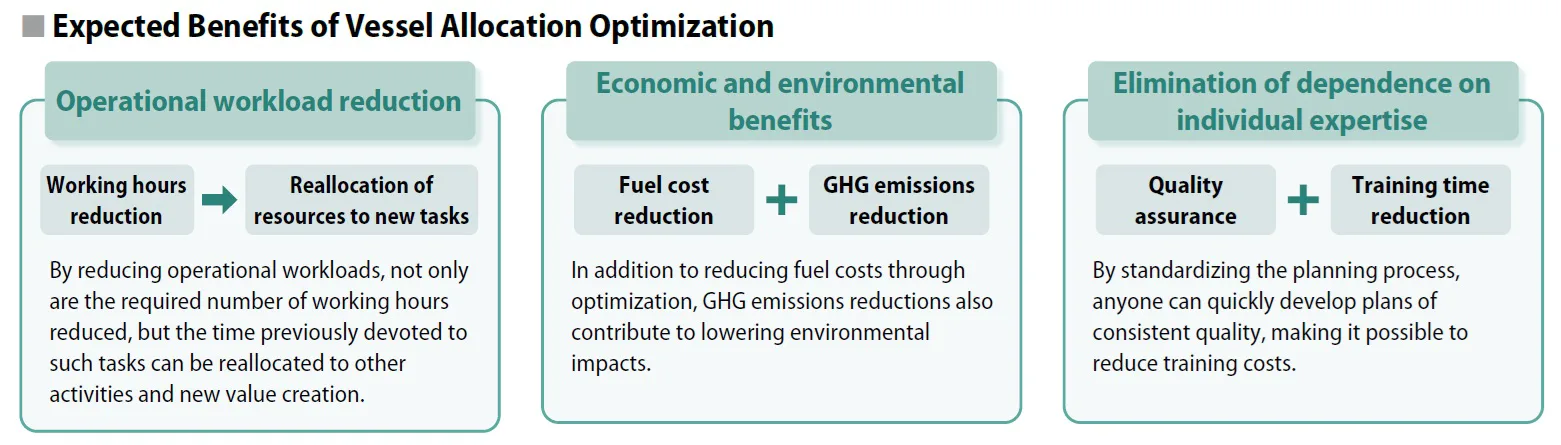
Regarding future developments, Nozaki states, “In addition to continuing to refine the system by operating it with car carriers, in the future we also want to take on the challenge of achieving integrated optimization that encompasses fleet capacity management and associated operations.”
Maeda points out that “In efforts to reduce GHG emissions, software-based approaches are extremely effective.” In addition to optimizing vessel allocation, NYK and MTI are working on initiatives such as slow steaming enabled by shorter cargo handling times and reducing GHG emissions per unit of transport through improved loading efficiency. He adds, “While hardware measures such as the installation of energy-saving devices, wind-assisted propulsion system, and fuel shift tend to attract attention, software has significant potential when considering both costs and emissions reduction effectiveness.”
Moreover, it has been noted that the use of AI has led to an increase in collaborations, such as this one, between companies and research institutions in the maritime industry. Maeda explains, “At MTI as well, not only personnel with traditional naval architecture backgrounds but an increasing number of people, me included, who have studied computer science and mathematics are joining the organization. The crossover of expertise between shipbuilding and IT engineers is leading to the creation of new value,” expressing his expectations for further advances in technological development through new collaborations.
Reedited from the KAIJI PRESS Special Issue published on March 31, 2026