For NYK FansOur Challenges


When you choose the dark mode display, you can reduce the power consumption and CO2 emissions generated by the website's screen display.
Released : May 28, 2026
Updated : May 28, 2026


In recent years, efforts toward digital transformation (DX) in the maritime industry have progressed. However, when viewed across the entire vessel life cycle, from design and construction to operation, there remains substantial room to incorporate digital transformation and further digitalization. Much of ship design still relies on 2D drawings, which require significant time to align understanding among stakeholders, including shipyards and shipping companies. In addition, the design documents after vessel completion are often provided as PDF files, making them difficult to utilize effectively as digital data. In response to these challenges, the NYK Group has been advancing the Ship Design Streamlining Project, led by MTI Co., Ltd., which has an R&D function, in collaboration with shipyards, design firms, and a classification society.
Under the Ship Design Streamlining Project launched in 2021, a system has been introduced that stores information such as vessel specifications and general arrangement drawings in a database and then converts it into 3D models for use. Design is advanced using a “front-loading” approach, and after a vessel enters service, digital finished plans are utilized to further evolve both vessel design and ship management.
Ship design proceeds in stages: development and planning, basic design, detailed design, production design, and finally, construction. “Front-loading” refers to advancing the peak of cost and resource allocation in this timeline and making critical decisions at the earliest possible stage. In conventional shipbuilding processes, the peak workload typically occurs during the middle to later phases, particularly during detailed design and production, and design changes made in these stages are likely to lead to increased costs and extended construction schedules. If design changes in the later phases can be reduced, overall productivity can be improved.
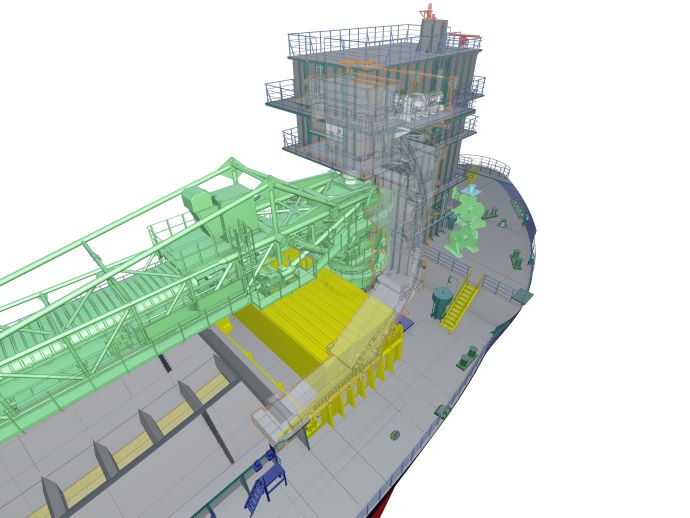
The key to front-loading is the use of 3D models. By using 3D models from the early stages, the vessel’s final form can be visualized, and layouts and specifications can be examined while confirming them visually. This reduces the need to revisit earlier steps in the process. In addition, by reviewing the process itself, it becomes possible not only to lower the peak of resource allocation but to reduce the overall workload.
While shipyards have been introducing 3D CAD systems, these have largely remained tools for internal design work. What is innovative about the NYK initiative is the use of 3D models as communication tools among stakeholders. Such use facilitates faster decision-making and smoother collaborative design. Complex layouts and structures that are difficult to understand from 2D drawings can be grasped intuitively through 3D visualization. This also allows far-away participants to connect via the internet and to hold discussions while viewing the same model.
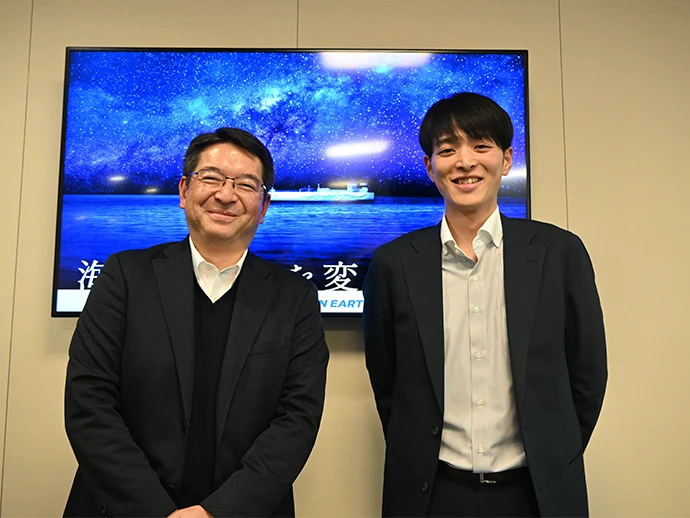
General Manager Hidehiko Sato of the Ship Business Group at NYK explains, “3D models can be understood intuitively at a glance, so they are also useful as tools for marketing to customers. Shipyards can use them when explaining designs to shipowners, and shipowners can use them when explaining vessels to shippers.” Sato has been involved in this project since he was seconded to MTI.
Building vessels based on 3D designs also enables leveraging accumulated data to develop digital tools that can be used for maintenance planning and maintenance history management, and these tools can be applied to future new building projects.
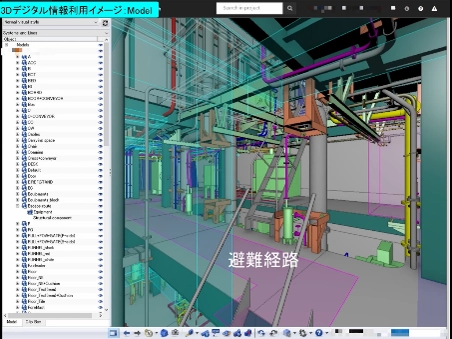
3D model of the vessel and ship's interior
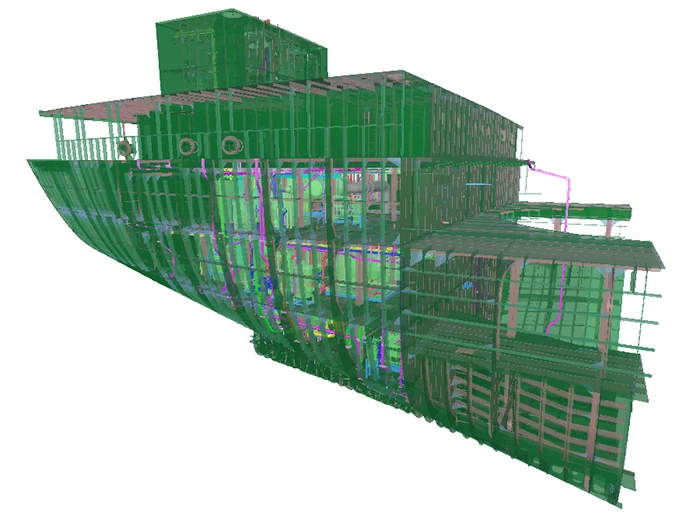
In 2024, a trial was conducted to apply 3D models in the initial design stage of vessel construction. In this trial, the NYK Group collaborated with Smert Design Co., Ltd., which engages in vessel design and system development using 3D CAD, and carried out a demonstration to design an LPG carrier for Kyoei Tanker Co., Ltd.. The vessel was built by Murakami Hide Shipbuilding Co., Ltd. and completed in September 2025. 3D models were created from the early stages of design and were used for specification reviews, decision-making, and the approval of drawings for detailed design.
This demonstration primarily used paper drawings, with 3D models employed in a supplementary role. As a result, the quantitative effects, such as reductions in working time, were limited. However, feedback from on-site personnel clearly indicated that “viewing unclear areas in 3D improves understanding,” raising expectations for broader adoption of 3D utilization in the future.
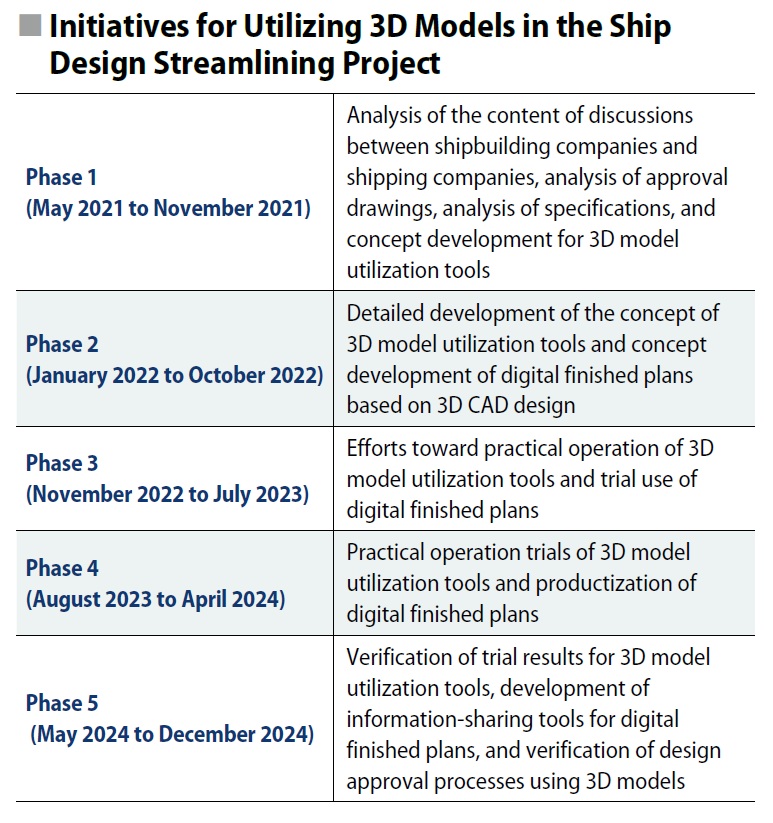
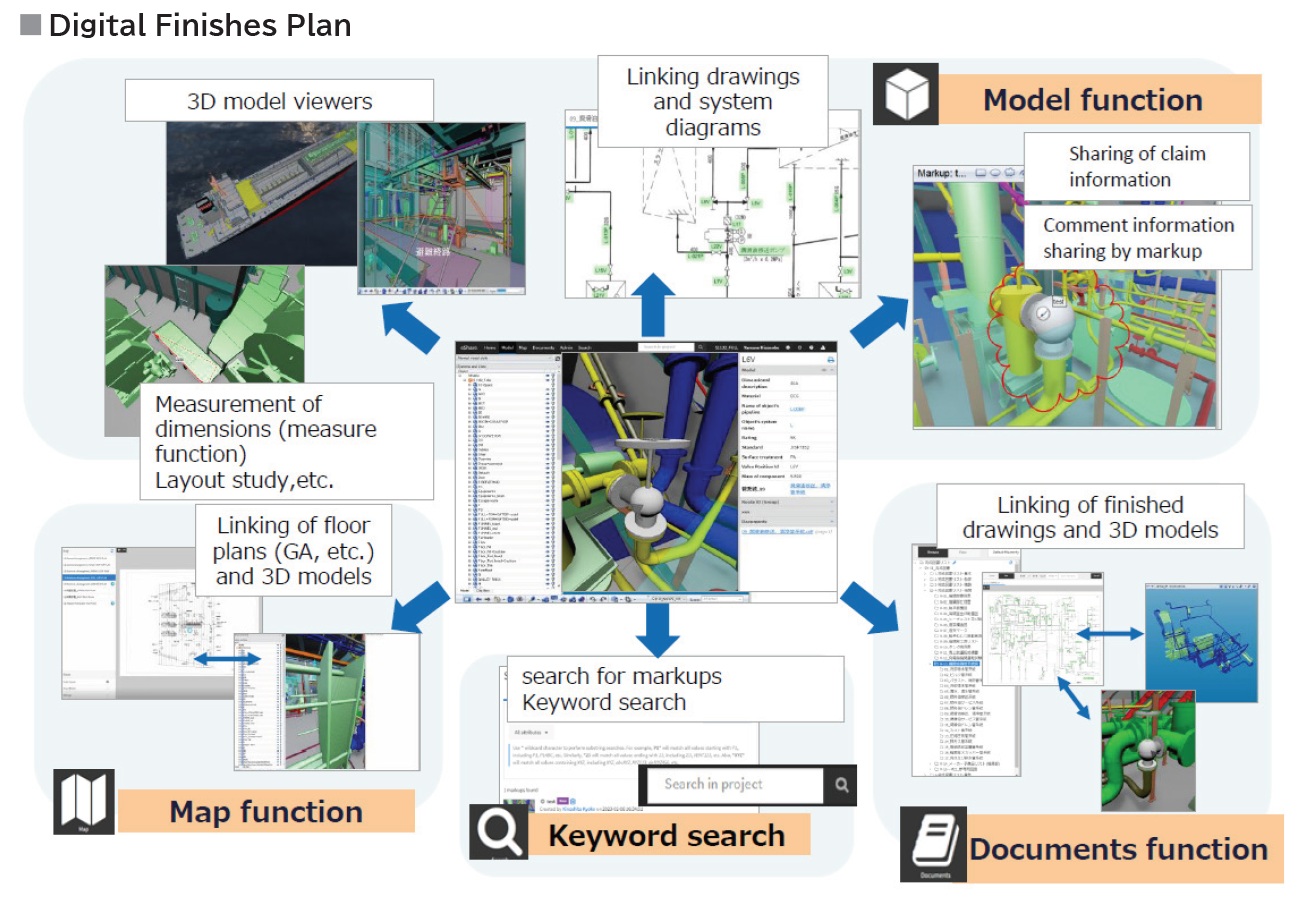
3D models also allow digital finished plans to be used for ship management after a vessel has been built. Various documents (including general arrangement drawings, system diagrams, and manuals) are integrated based on data created through 3D design. By simply clicking on equipment or piping within the 3D model, users can immediately access the relevant materials for that specific section. Previously, it was necessary to search for documents each time in storage rooms or digital folders, but digital finished plans significantly reduce the effort required. In addition to linking finished plans provided by shipyards, it is possible to jump from 2D drawings to the corresponding 3D locations, measure dimensions by moving the cursor, and insert comments about defects or repair records. These functions provide substantial practical benefits for seafarers and ship management supervisors.
Ideally, 3D models should be used from the vessel design stage and continued to be used after completion. However, it is also true that it is not easy to fundamentally change long-established practices at the shipyards responsible for design. Therefore, NYK has adopted a strategy of promoting the use of digital finished plans for after vessel completion— in other words, in the downstream phase of the life cycle—to demonstrate value enhancement. Based on this, the company aims to eventually extend adoption to the upstream phase, namely the early design stage.
Trials of actual vessels are also underway in preparation for the commercialization of Smert Design’s digital finished plans. Asia Pacific Marine Corporation, a coastal shipping company, is using an alpha version of digital finished plans for two coal carriers in its vessel management operations. Sato stated, “Digital finished plans have been highly evaluated for their ease of use, and we hear that they are easy to use not only as a ship-to-shore communication tool but for explaining matters to cement companies, which are the shippers.” Digital finished plans are also being actively used for Kyoei Tanker’s LPG carrier mentioned above.
As the next project, initiatives are underway to use 3D laser scanning to create 3D models of existing vessels without 3D data. The vessel interior is scanned to generate point cloud data, which is then processed into a 3D model. By linking this model to existing drawings and documents, it is possible to independently generate digital finished plans.
Integration with existing ship management systems gives digital finished plans further development potential. In the initiative with Asia Pacific Marine, linking digital finished plans with the vessel maintenance management system the company already operates enables maintenance reports to be associated with 3D models, allowing users to visually identify which equipment and parts of that equipment the work relates to. Sato stated, “We believe that digital finished plans can be made even more user-friendly by adapting them to the existing systems of each ship-management company.”
Looking further ahead, there is the potential for utilization at fleet operation centers (FOC) for autonomous vessels. If the actual layout and condition of equipment can be checked in 3D, operational management scenarios in which a shore-based chief engineer at an FOC provides instructions to onboard engineers will become increasingly realistic.
With a view to improving the efficiency of ship design through the use of 3D models and expanding their utilization after completion, Sato emphasizes, “From the perspective of a shipping company, we want to develop tools that stay close to the work of designers.” He also stresses that, for these initiatives to becomede facto industry standards, it is important that the new tools be universal rather than tailored to individual companies. Concept development should be part of the cooperative domain, while tool development and utilization under new concepts should be part of the competitive domain. Initiatives in which vessel builders and vessel users work together are steadily progressing.
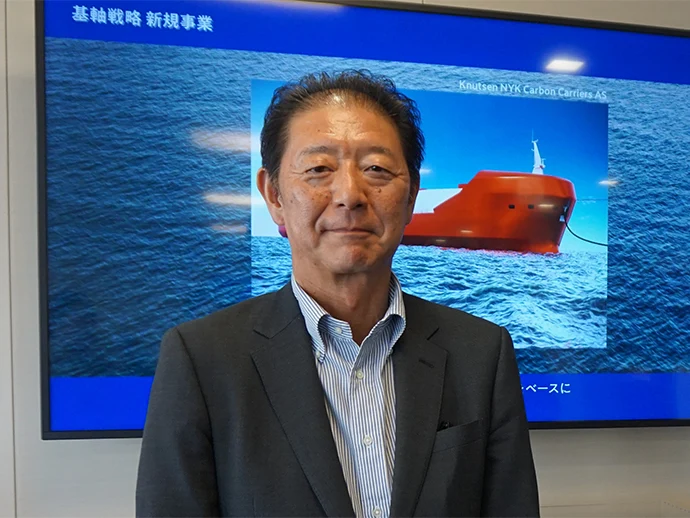
–– You have been working on the 3D model utilization project. How do you feel about the progress so far?
I have been involved in work across the entire vessel life cycle, from completion through to operation, including responsibilities for newbuilding technology and ship management. My sense of the issues regarding newbuilding design developed during my time as a technical manager for newbuildings and became a research theme when I was seconded to MTI. Once we got started, the response from those around us was positive. At the same time, there were also comments about hurdles in the actual implementation. Since this initiative involves changing conventional processes, such a reaction is understandable. Even so, thanks to the people who have viewed the initiative favorably, we have been able to continue this effort over the long term.
–– After being involved in research on 3D models, you are now in a sales position in which you introduce the NYK Group’s technologies to external parties.
I find it interesting to market something I developed myself, and I feel I am in the right position at the right time.
–– What is your message to those who aspire to become engineers?
One attractive aspect is that you can engage in work with a broad scope. Within engineering, there are many different fields. It is easy to become confined to a single area, such as marine engineering or technical management, but there are opportunities to take on work that goes beyond these boundaries, including R&D and technical sales. I feel that the stages in which engineers are involved are gradually expanding. I would like people not to become overly focused on their own specialties, but to boldly take on new roles from a broad perspective. Of course, becoming involved in fields you did not originally imagine may present hurdles, but this can also create new opportunities. By accepting such challenges with an open and flexible mindset, you may be able to see new directions for your own growth.
Reedited from the KAIJI PRESS Special Issue published on March 31, 2026