For NYK FansOur Challenges

When you choose the dark mode display, you can reduce the power consumption and CO2 emissions generated by the website's screen display.
Released : May 22, 2026
Updated : May 21, 2026


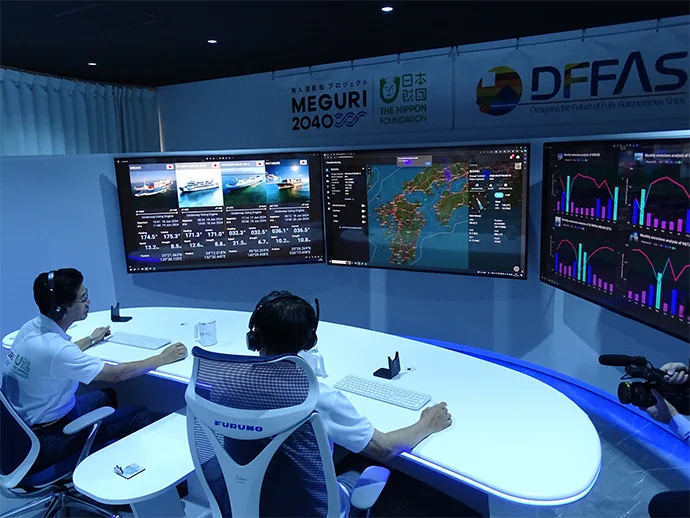
The NYK Group plays a central role in the Nippon Foundations MEGURI2040 Fully Autonomous Ship Program, which targets Japan’s coastal shipping sector. In Stage 2 of this project, the aim is to achieve conditional autonomous navigation, which is defined as an automation level at which fully autonomous navigation is partially possible, equivalent to Level 4 for self-driving automobiles. As a result, the project is attracting global attention as one of the most advanced initiatives in the maritime industry. Through an all-Japan effort involving not only the maritime industry but participants from other industries, the project is advancing the development of cutting-edge technologies while working to establish rules for social implementation and to foster public understanding through information dissemination. The project outcomes will also form a foundation for Japan to take the lead in the development of international rules on autonomous ships at the International Maritime Organization (IMO).
The Nippon Foundation’s MEGURI2040 is a project that promotes technological development with the aim of realizing fully autonomous ships in order to address social issues such as the labor shortage in the coastal shipping sector caused by Japan’s aging and declining population as well as marine accidents resulting from human error, while strengthening the competitiveness of Japan’s maritime industry. In Stage 1 of the project, which was implemented from 2020 to 2022, demonstration voyages of fully autonomous navigation by coastal vessels were successfully carried out ahead of the rest of the world, involving five consortia and six vessels. Building on this achievement, in Stage 2, which began in 2023, the aim is not only to conduct social trials of fully autonomous navigation but to significantly advance social implementation.
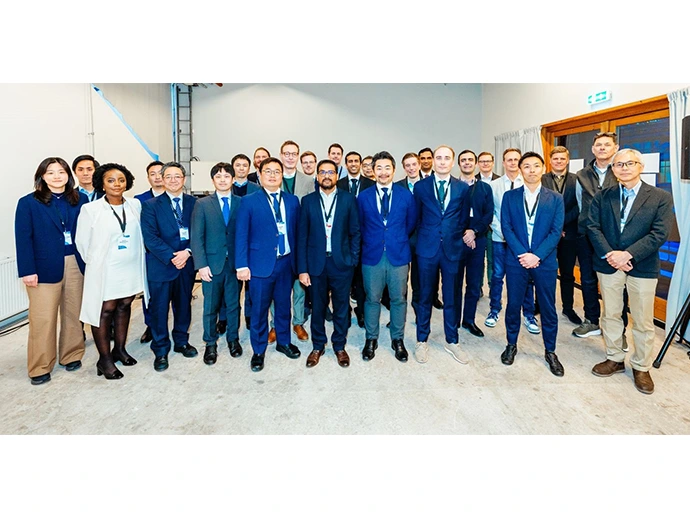
In Stage 2, members of the consortia that participated in Stage 1 have united under a single framework, forming an all-Japan consortium consisting of 53 companies. Including domestic and overseas partner organizations, the consortium involves more than 100 entities that are advancing development through open innovation. Participation extends beyond the maritime cluster—which includes shipping, shipbuilding, and marine equipment companies—to companies from other industries. Stages 1 and 2 each are projects on the scale of approximately 10 billion yen, with more than 80% of the funding provided by the Nippon Foundation.
In terms of technological development, the project is working on autonomous maneuvering; automated berthing, unberthing, and mooring technologies; simultaneous remote support of multiple vessels; and the establishment of more stable ship-to-shore communication. Demonstrations of fully autonomous navigation will be conducted using a total of four vessels having different ship types, designs, and routes, consisting of two containerships (including a newly built vessel), one existing Ro-Ro vessel, and one remote-island passenger ferry. These demonstrations will be supported by two types of Fleet Operation Centers (FOCs), namely a permanent center and a mobile center designed for disaster response. The initiative places strong emphasis on social implementation, including simultaneous monitoring and support of multiple vessels from the FOCs. Providing navigational support from shore to multiple fully autonomous ships at the same time is a world first.
The four demonstration vessels are shown in the accompanying table. The FOC equipped with all shore support functions—including operation monitoring of multiple vessels, individual support for navigation functions and engine functions, and voyage planning—has been completed on the premises of Furuno Electric Co., Ltd. in Nishinomiya City, Hyogo Prefecture. In addition, a mobile FOC has been developed by Japan Radio Co., Ltd. that compactly integrates the functions required for shore support, enabling simultaneous monitoring of multiple vessels with an eye toward future widespread adoption and ensuring redundancy during disasters.
Because the project aims at social implementation, it places importance not only on technological development but on rulemaking and fostering social understanding of fully autonomous ships for future generations. With regard to rulemaking, the project seeks to achieve social implementation through deregulation while strengthening the competitiveness of Japan’s maritime industry through international standardization.
Unlike automobiles, it is difficult to test ships using full scale physical prototypes. For this reason, simulation technologies are also utilized during the design phase. The project further serves as a venue for putting into practice digital engineering methods that make use of simulation technologies developed under the University of Tokyo’s industry-academia collaborative Maritime and Ocean Digital Engineering (MODE) Program, in which the maritime industry, including the NYK Group, participates.
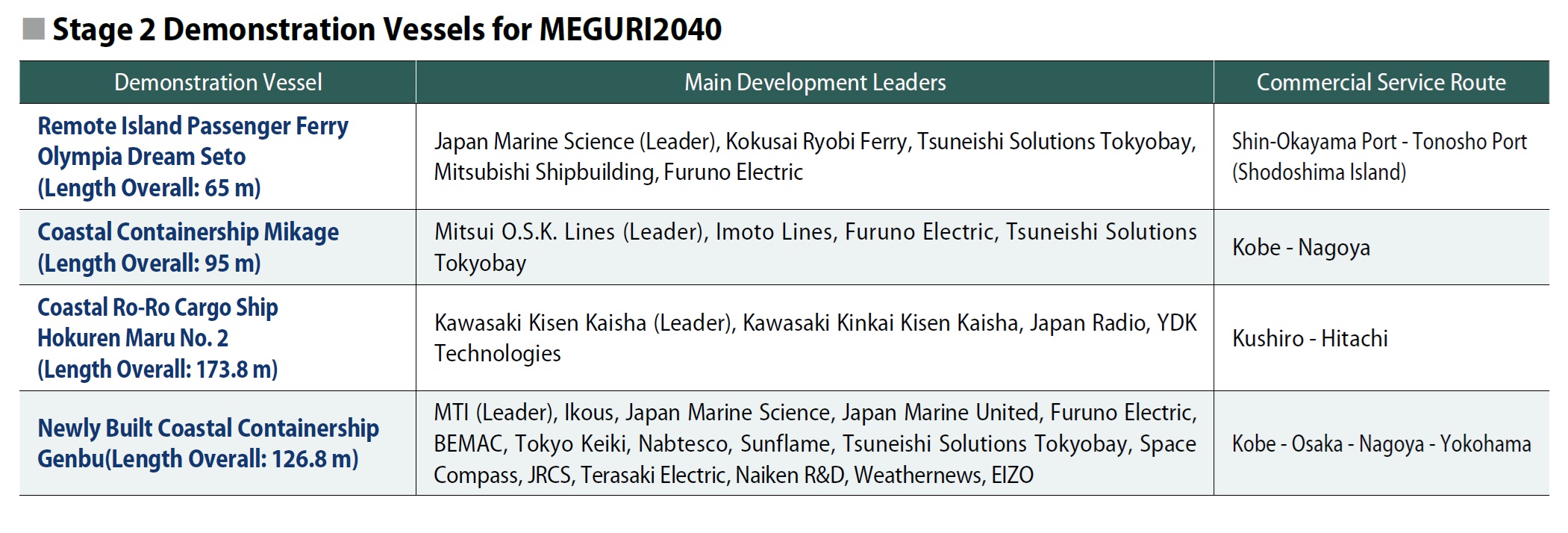
Of the four demonstration vessels, Olympia Dream Seto passed the national ship inspection in December 2025 to become Japan’s first certified “autonomous ship,” completing preparations for commercial operation. According to research by the Nippon Foundation, this will be the world’s first case of regular commercial operation on a scheduled passenger route carrying general passengers using “technology equivalent to Level 4 for self-driving,” which refers to the stage at which fully autonomous operation without human intervention is partially possible in specific areas or under specific conditions. As the definitions for such levels in the context of ships are under discussion at international forums such as the IMO, the definition from the automotive field is being applied provisionally.
Olympia Dream Seto is a remote island ferry with a passenger capacity of 500 operated by Kokusai Ryobi Ferry Co., Ltd. that serves the route between Shin-Okayama Port in Okayama City and Tonosho Port on Shodoshima Island in Kagawa Prefecture. Under the MEGURI2040 project, the ferry has been used as a test ship for automation demonstrations on remote island routes. In the Seto Inland Sea, where vessel traffic is heavy and where numerous islands and rock reefs pose navigational obstacles, safety evaluations have been conducted to verify whether systems such as sensors and planners, which automatically generate collision-avoidance routes, function appropriately. In order for a vessel to operate as an autonomous ship with only onboard crew, it must undergo two inspections. The first inspection is conducted at the design stage, prior to equipment installation, aboard the vessel. Upon passing this inspection, a certificate is issued designating the vessel as an “initial-stage autonomous ship,” in which human involvement is required for all tasks of the autonomous navigation system. If the vessel subsequently passes the second inspection, the vessel is permitted to operate as an autonomous ship with onboard crew only, without the presence of the developers. Olympia Dream Seto passed these two inspections in July and December 2025, respectively.
The plan is to have the remaining three vessels equipped with autonomous navigation functions under MEGURI2040 sequentially pass the required inspections and to conduct simultaneous operation of all four vessels.
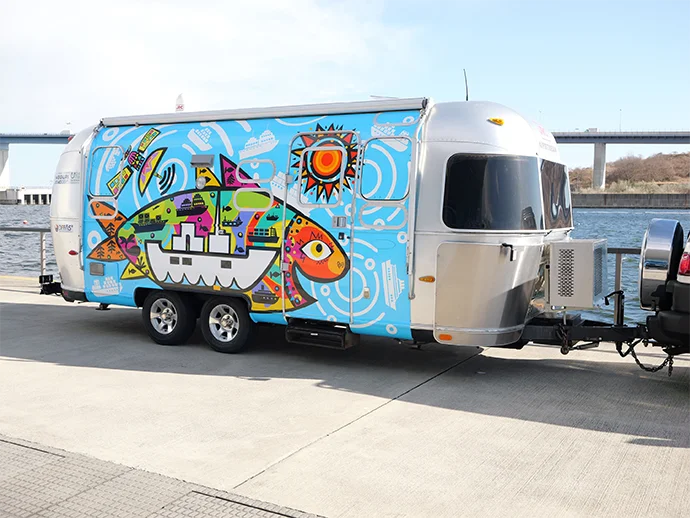
Mobile FOC(The Nippon Foundation)
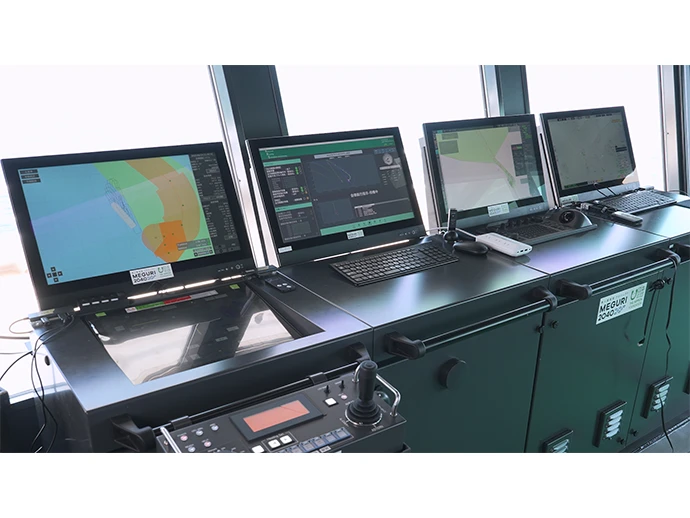
Autonomous navigation equipment installed on Olympia Dream Seto (The Nippon Foundation)
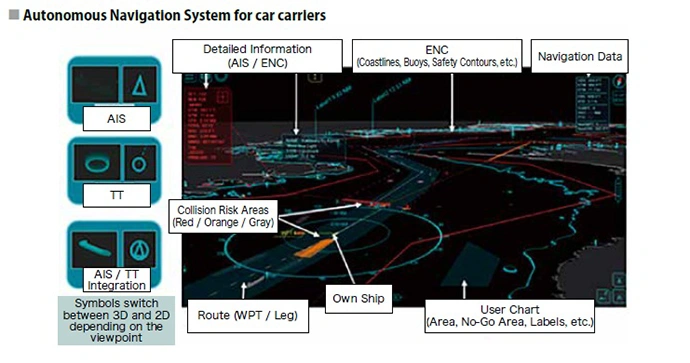
NYK has begun leveraging the development achievements of MEGURI2040. With the aim of ensuring safe navigation and improving the efficiency of onboard operations, the company has decided to install the latest marine DX equipment on a car carrier that is scheduled for completion at Shin Kurushima Toyohashi Shipbuilding Co., Ltd. in March 2026. The vessel will be equipped with an autonomous navigation system developed under MEGURI2040, together with a large motion mitigation system and a Wi-Fi network covering the entire vessel. Trials will be conducted during actual commercial voyages to verify the effectiveness of these systems.
The autonomous navigation system automatically avoids collisions and groundings under crew supervision, thus supporting safe navigation. It assists with tasks during navigational watchkeeping that were previously performed manually by navigators, including information gathering, situation analysis, and collision-avoidance planning. By reducing navigators’ workloads, which have increased due to vessel upsizing, rising traffic volumes, and the growing complexity of onboard equipment, the system helps prevent accidents caused by human error.
The autonomous navigation system that NYK has installed collects information from the surroundings and analyzes the situation using image recognition technology powered by AI and automatic radar target analysis technology. In addition to visualizing information such as collision risks, the system formulates collision-avoidance plans and performs automatic maneuvering. It is also possible to immediately switch to conventional manual maneuvering performed by the crew.
The large motion mitigation system uses wave data observed by dedicated radar to simulate vessel motions based on the vessel’s condition, and, based on the results, proposes to the navigator a course and speed that will minimize vessel motion. By preventing excessive motion, the system aims to protect cargo and enhance safety. Even under identical sea conditions, vessel behavior can vary significantly depending on course and speed, so digital technologies are employed to support navigational decision-making.
The vessel is also equipped with Wi-Fi access points throughout the ship, significantly improving the onboard communication environment. Although the ship-to-shore communication environment has been steadily improving with the development of satellite communications, at present, the locations where communication is possible onboard are limited to areas such as the bridge and accommodation areas. In operational areas such as the engine room, on deck, and inside cargo holds, it can be difficult to access online manuals and materials, to check the status of troubles through real-time video, and to communicate with shore-based medical institutions in the event of an injury or illness. In addition, because the hull is made of metal, in some locations, the handheld radios used for onboard communication do not function effectively, which can interfere with daily operations. Ensuring Wi-Fi access addresses such issues, enabling more efficient onboard operations and the realization of safe navigation.
–– What is the significance of MEGURI2040?
Labor shortages are a social issue that also affects the shipping industry, and in particular, coastal vessels and passenger ships have already begun to suspend operations due to a lack of seafarers. In response to this social issue, the Nippon Foundation believes that fully autonomous ships are one potential solution. With the aim of maintaining the soundness of domestic logistics and passenger transportation through the social implementation of fully autonomous ships, the Nippon Foundation launched MEGURI2040, and the NYK Group is participating in this initiative. Today, we live in an era in which goods can be delivered the very next day with just a tap on a smartphone, making it easy to overlook the importance of maritime shipping in supporting domestic logistics. However, through the COVID-19 pandemic, I believe that the general public has once again come to recognize that maritime shipping disruptions have significant impacts on daily life. Given these circumstances, this project’s major significance lies in realizing sustainable maritime transportation for Japan, a maritime nation.
–– What are the objectives of MEGURI2040?
The first objective is to ensure transportation stability in response to the risk that a shortage of seafarers could undermine the soundness of domestic logistics. The second objective is to reduce onboard workloads as a measure to address the seafarer shortage. The third objective is to further enhance safety by providing advanced system support that accounts for human limitations, given that approximately 80% of maritime accidents are said to be caused by human error.
People tend not to look squarely at their own weaknesses. From my own experience as a seafarer, there are clear limitations to visual lookout during nighttime navigation, and as we grow older, both our eyesight and concentration gradually decline. Taking these realities fully into account, I believe we should actively incorporate technologies that compensate for human limitations. What we aim to achieve through MEGURI2040 is a system that supports safe navigation. The initial challenge given by the Nippon Foundation was the concept of achieving “completely unmanned.” While this is technically possible, social implementation is by no means easy when taking into consideration factors such as the development of rules and regulations. As an engineer, I do keep in mind the idea of a future state of being “completely unmanned.” However, to address the social challenges right in front of us, we held extensive discussions with the Nippon Foundation within MEGURI2040 to define the goals we should realistically pursue. The system we have developed can operate vessels without onboard personnel when conditions permit, but it is not designed for fully hands-off operation 24 hours a day, 365 days a year. This design allows for human intervention in situations where traffic congestion is high and the risk of collision is significantly elevated, or when system stability declines. In other words, the concept is that the bridge is unmanned, while personnel remain on the vessel.
–– How do you see crew reduction playing out in practice?
For example, a coastal cargo vessel of 749 gross tons or more is normally operated with six navigation watch personnel, consisting of two people per watch across three shifts. By replacing the role of one watchkeeper with the system, it becomes possible to operate with a three-person structure, consisting of one person per watch across three shifts. As for engine personnel, a vessel is typically crewed by a chief engineer and another engineer. By assigning the chief engineer to an FOC and providing support remotely, it becomes possible to address the labor shortage. Looking ahead, we are also working with future business models in mind, such as securing human resources by having a person with experience of seafarer work at FOCs established in various regions.
In addition, it may become possible for seafarers to hold a Class 6 license, which is an entry level qualification for coastal vessels, to operate vessels equivalent to Class 4 under system support and shore-based assistance, similar to how drivers with only an automatic transmission license can operate motor vehicles. By reducing workloads, we aim to ensure that vessels can be operated safely even with fewer people—in other words, we aim to make ships easier to operate as a means of transportation. When we talk about reducing workloads, it is easy to think only in terms of shorter working hours, but reducing the mental and psychological burdens are equally important.
–– What is the NYK Group’s role in MEGURI2040?
In Stage 2 of MEGURI2040, the number of participating companies has expanded to 53, and when partner companies are included, the project now involves more than 100 organizations. We are also in communication with overseas manufacturers and research institutions. I serve as the project director of the MEGURI2040 consortium, overseeing the entire project, and I also act as the primary point of contact with relevant authorities and organizations such as the Ministry of Land, Infrastructure, Transport and Tourism; the Japan Coast Guard; and the All Japan Seamen’s Union.
What is expected of the NYK Group, including Japan Marine Science and MTI, is our ability to accurately convey the voices of users to manufacturers. In overseas markets, where manufacturers tend to have stronger influence, the common approach is for manufacturers to promote the use of their own technologies. In contrast, Japanese manufacturers generally maintain flatter relationships with users and have a strong mindset of developing the products that users truly want. However, it is not easy to translate the on-site impressions of seafarers, such as “this feels a bit different” or “this is what we really need,” into quantitative terms that manufacturers can act on. Given this situation, the NYK Group can bridge the gap by drawing on our experience as a shipping company that understands vessels and logistics operations, as well as our long history of working together with manufacturers in Japan and overseas on a wide range of technological developments.
In addition, it is extremely important to present a clear vision of the future of development to both users and manufacturers. Users can benefit from safer and more efficient operations, while manufacturers can see their technologies contributing to society and becoming viable businesses. By ensuring that all parties recognize this is a win-win relationship, companies gain confidence in the project and choose to participate. Although Stage 2 of MEGURI2040 has been extended and is scheduled to run until September 2026, NYK plans to leverage the project outcomes by installing a fully autonomous navigation system on a car carrier that is scheduled for completion in March 2026 at Shin Kurushima Toyohashi Shipbuilding, thereby further enhancing navigational safety, which is our core mission.
If you come to visit the actual project site you will be able to see, but the MEGURI2040 consortium has an atmosphere much like a high school extracurricular club, where participants freely exchange ideas while carrying out development in a lively manner regardless of their affiliation or position. Japanese culture makes it easier for people to come together in a fleet-like formation, setting aside individual interests and working collectively toward a common goal. At the same time, there is a risk that such a group can lose direction if no one takes the lead. I believe the NYK Group is expected to play that driving role to prevent the project from becoming a loosely connected gathering.
In MEGURI2040, we are making efforts not only toward technological development but toward creating the necessary environment, including rulemaking related to fully autonomous ships. Coordination with a wide range of stakeholders, including the Ministry of Land, Infrastructure, Transport and Tourism, is another major role of ours. Because such an enabling environment cannot be built by the maritime cluster alone, companies from other industries, such as telecommunications providers and insurance companies, are also participating. Acting as a coordinator between the various industries is likewise an important role of ours.
–– Are there any other points you would like people to pay attention to?
In MEGURI2040, we place strong emphasis on external communication. In the development and social implementation of new technologies such as these, there are two important perspectives: safety and reassurance. While technological development can enhance safety, successful social implementation also requires efforts to improve public understanding and acceptance so that people feel reassured about the safety of fully autonomous ships.
In addition, we are making efforts to ensure that MEGURI2040 attracts broad public attention in order to spark children's interest in maritime careers and to encourage system engineers, who are in high demand across many fields, to consider working in maritime-related development. For example, we hold tours for children at an FOC designed in a science-fiction-inspired style to generate a sense of excitement, and we have organized public calls for exterior design ideas for the mobile FOC, which can be seen by the public. We value a sense of playfulness as a way to engage more people and generate wider interest.
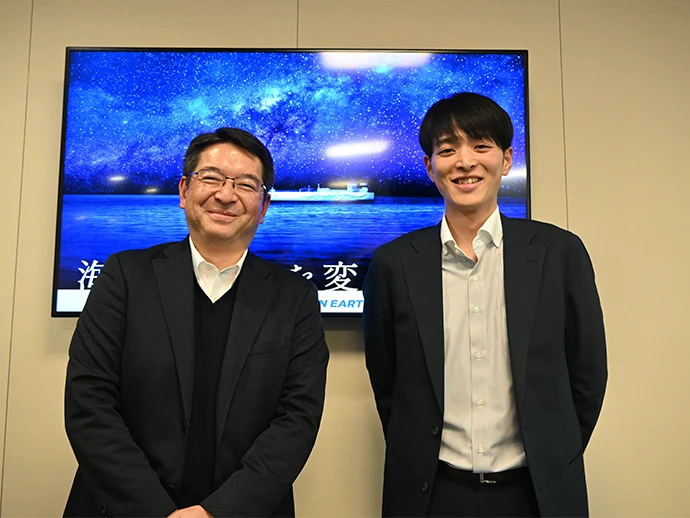
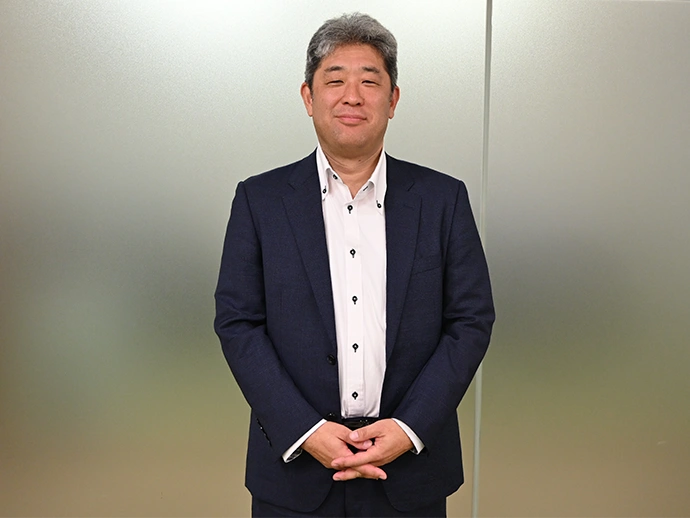
Joined NYK in 1994. After accumulating experience through multiple assignments both at sea, including service on crude oil tankers, and in shore-based positions, he was seconded to Japan Marine Science in 2017. He currently serves as project director of the MEGURI2040 consortium, overseeing the entire project.
Reedited from the KAIJI PRESS Special Issue published on March 31, 2026