What is NYK?History


When you choose the dark mode display, you can reduce the power consumption and CO2 emissions generated by the website's screen display.
Released : Nov. 04, 2026
Updated : Nov. 04, 2026


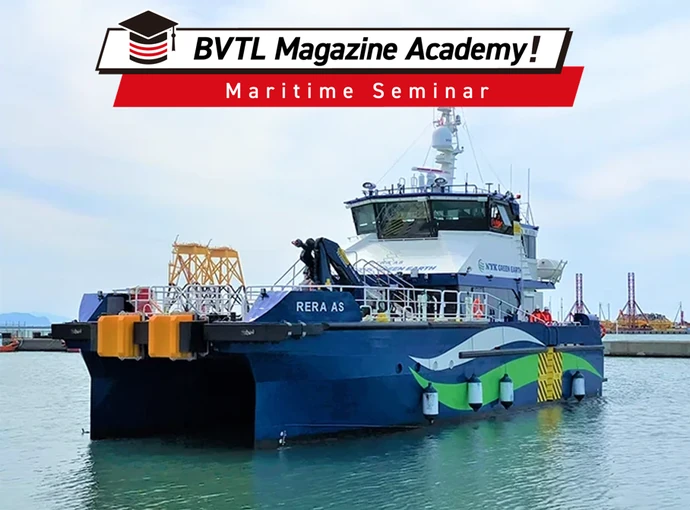
• Specialized vessels play vital roles in offshore wind projects, from construction through operation.
• Seabed survey vessels equipped with specialized instruments investigate conditions at prospective construction sites.
• Module carriers with reinforced decks transport enormous blades and foundation components.
• SEP vessels, equipped with “legs,” are essential for turbine installation.
• CTVs and accommodation-capable SOVs support stable operations by transporting personnel and providing offshore living facilities.
This article offers a comprehensive overview of the specialized vessels used to support the construction and operation of bottom-fixed offshore wind farms — from initial site surveys through construction to ongoing maintenance.
As the global adoption of renewable energy continues to accelerate, offshore wind power is becoming an increasingly important component of the energy mix. It has achieved notable success in regions with extensive continental shelves, such as the North Sea in Europe and, more recently, parts of the East China Sea. These areas offer favorable conditions for large-scale offshore wind development.
For Japan, where limited land availability restricts suitable locations for onshore wind turbines, offshore wind power presents significant potential. Although rising labor and material costs have led to revisions of some projects in the short term, demand is expected to grow over the medium to long term.
A wide range of specialized vessels is indispensable throughout the lifecycle of offshore wind projects, from construction to operation. Many shipping companies are actively engaged in developing and operating these vessels, viewing them in terms of both social responsibility and new business opportunities.
This article introduces the vessels that support bottom-fixed offshore wind projects, a technology already being deployed on a large commercial scale. We will explore their characteristics and roles in an easy-to-understand manner.
Before offshore wind turbines can be installed, it is essential to investigate whether the seabed conditions are suitable for supporting the foundations. Two commonly used geotechnical survey methods are the cone penetration test (CPT) and the standard penetration test (SPT).
The CPT involves pushing a rod fitted with a cone-shaped tip into the ground while measuring tip resistance, sleeve friction, and pore water pressure. It is particularly effective for examining soft soil conditions and provides detailed information about subsurface characteristics.
The SPT involves drilling a borehole and driving a sampler attached to a rod into the ground using a hammer. The number of hammer blows required is used to estimate soil strength.
Because these surveys must be conducted offshore, dedicated or multipurpose seabed survey vessels are employed. These vessels are equipped with specialized machinery and facilities that enable stable testing operations. Even under changing sea conditions, such as waves and wind, seabed survey vessels allow survey work to be carried out accurately and safely.
The construction of offshore wind farms requires the transportation of enormous components, including blades, nacelles, tower sections, and foundation structures such as monopiles and jackets.
While blades used for onshore wind farms are already large, offshore wind turbines tend to be even larger to harness stronger and more consistent winds at sea. As a result, transporting these components is often beyond the capabilities of conventional container ships or general cargo vessels, making specialized heavy-lift carriers essential.
One type of vessel used to transport jacket foundations is the module carrier. These vessels feature wide, flat decks and can accommodate large cargoes loaded directly using multi-axle transporters through a roll-on/roll-off (Ro-Ro) method. Module carriers transport offshore wind components from manufacturing facilities to ports near construction sites or, in some cases, directly to offshore installation locations.
Individual blades can exceed 80 meters in length, while tower sections are extremely heavy. To handle such cargo safely and efficiently, module carriers are equipped with high-strength decks and specialized securing systems.
Successful transportation depends heavily on detailed planning, including the design of blade supports and decisions regarding the orientation and arrangement of tower sections. Thorough preparation enables the entire logistics process, including cargo handling in ports and on land, to be optimized.
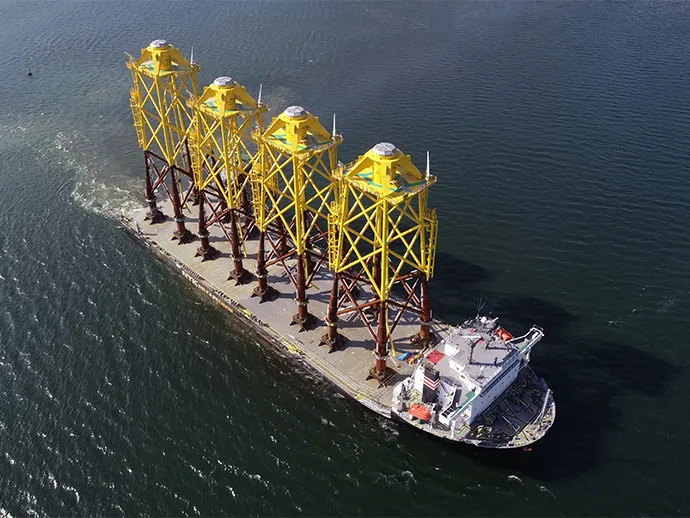
Module carrier transporting jacket foundations for an offshore wind farm
Project: TPC Offshore Windfarm Phase 1 Project – Demonstration
Contractor: Consortium Jan De Nul n.v. – Hitachi Ltd.
Source: NYK Bulk & Projects Carriers Ltd.
The self-elevating platform (SEP) vessel plays a central role in turbine installation. Equipped with long supporting legs that can be lowered to the seabed, it elevates its hull above the water surface, creating a stable working platform. Because of this mechanism, SEP vessels are also known as jack-up vessels.
By providing a work environment that is less affected by waves and wind, SEP vessels enable the safe and efficient assembly and maintenance of wind turbines using large cranes offshore.
Electricity generated by offshore wind farms must be transmitted to shore through subsea power cables. The installation of these cables is carried out by cable-laying vessels. These vessels are equipped with large cable storage facilities, specialized cable deployment systems, and advanced positioning technologies that enable accurate cable placement along the seabed.
Some cable-laying vessels are also equipped with remotely operated vehicles (ROVs) that are used to inspect seabed conditions and monitor cable integrity, helping prevent potential problems before they occur.
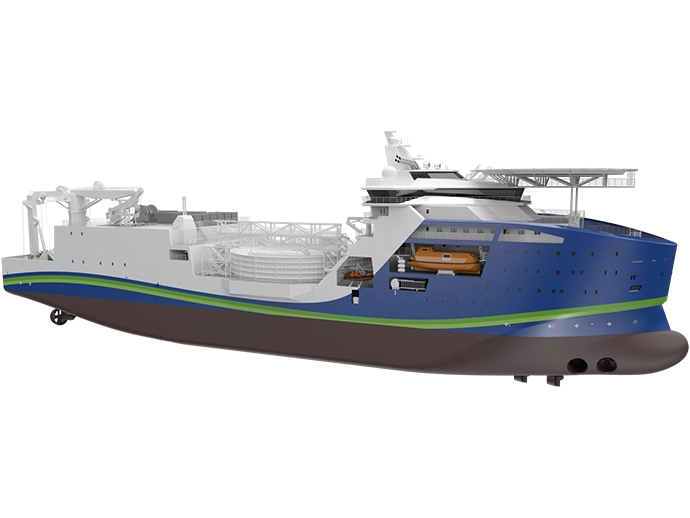
Concept image of a cable-laying vessel
Source: NYK Line press release, “NYK Obtains Approval in Principle (AiP) for the design concept for Long-Distance Subsea Cable-Laying Vessel,”
https://www.nyk.com/english/news/2024/20241204.html
Once an offshore wind farm enters service, maintenance personnel must regularly travel to and from the turbines. This role is fulfilled by crew transfer vessels (CTVs).
CTVs are small vessels designed for high-speed operation and can transport several dozen technicians at a time. They also provide space for carrying small equipment and tools when needed, allowing them to respond flexibly in emergencies. In addition, their hull designs help minimize the effects of waves, improving comfort for personnel during transit.
Large offshore wind farms often require long-term maintenance work, creating a need for offshore accommodation. This is where service operation vessels (SOVs) come into play.
SOVs provide hotel-like accommodations and can house dozens or even hundreds of personnel for extended periods. In addition to private cabins, they feature shared facilities such as dining areas and recreational spaces. Some vessels are also equipped with helicopter decks and small workboats. SOVs serve as vital offshore bases that enable personnel to work comfortably during long-term maintenance operations.
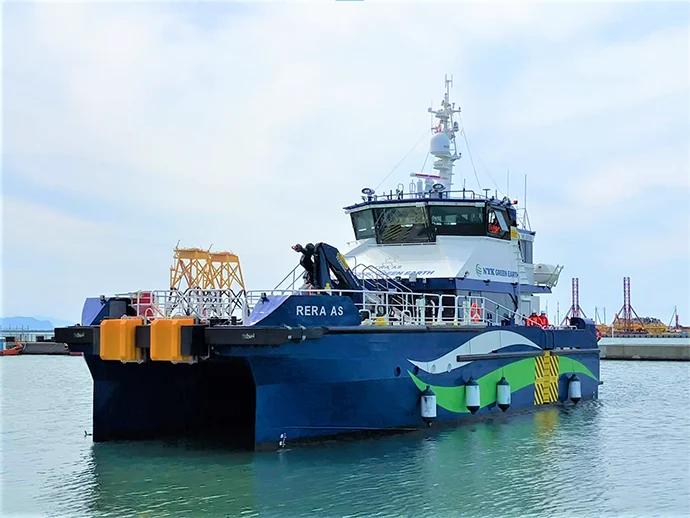
Rera As, a CTV operated by NYK Line
Source: NYK Line press release, “New Crew Transfer Vessel for Ishikari Bay New Port Offshore Wind Farm Arrives in Japan,”
https://www.nyk.com/english/news/2023/20230420_1.html
This article has introduced the diverse range of vessels that support offshore wind projects, from surveying and planning to construction, operation, and maintenance. In reality, many other vessel types also contribute to different phases of these projects. As floating offshore wind turbines come into practical use, additional vessels will likely be required to support them. For Japan, where usable land is limited, offshore wind power is expected to become an increasingly important new option for ensuring a stable energy supply. As the industry continues to grow, it is worth paying attention not only to the turbines themselves but also to the vessels working behind the scenes to make offshore wind power possible.