What is NYK?Events


When you choose the dark mode display, you can reduce the power consumption and CO2 emissions generated by the website's screen display.
Released : Oct. 09, 2026
Updated : Oct. 09, 2026


• The launch of the second Trump administration has renewed interest in U.S. trade and maritime policies.
• Despite being the world's largest economy, the United States accounts for only about 2.1% of the world's controlled fleet tonnage, ranking 12th globally.
• Former U.S. ocean carriers such as SeaLand and APL have disappeared from the international market, significantly reducing the country's competitiveness in global shipping.
• The Jones Act, which protects domestic shipping, has also contributed to higher costs across the U.S. maritime industry.
• Shifts in maritime dominance between the United States and China are emerging as important issues in both economic and national security policy.
The United States possesses the world's largest economy. Yet when it comes to shipping, its presence is surprisingly limited. Why is that? The answer becomes clearer when viewed through the lenses of history and data.
Several months have passed since the inauguration of the second Trump administration. Since taking office, President Trump has moved quickly on issues related to trade, foreign policy, and national security, and the maritime sector is beginning to feel the effects. For industry observers and researchers, closely monitoring the administration's policy direction has become increasingly important.
Many shipping-related policies are still under discussion, and concrete measures have yet to emerge. Nevertheless, it is clear that political interest in maritime affairs is growing in the United States. Shipping is closely tied not only to trade but also to national security and strategic competition with China. Developments in this field could therefore have implications for the global economy as a whole.
Against this backdrop of renewed attention, this article provides an overview of the current state and historical development of the U.S. shipping industry. The United States is the world's largest economy and possesses the world's most powerful navy, yet it is rarely regarded as a major shipping power. Why is that the case? Let us explore the answer through history and numbers.
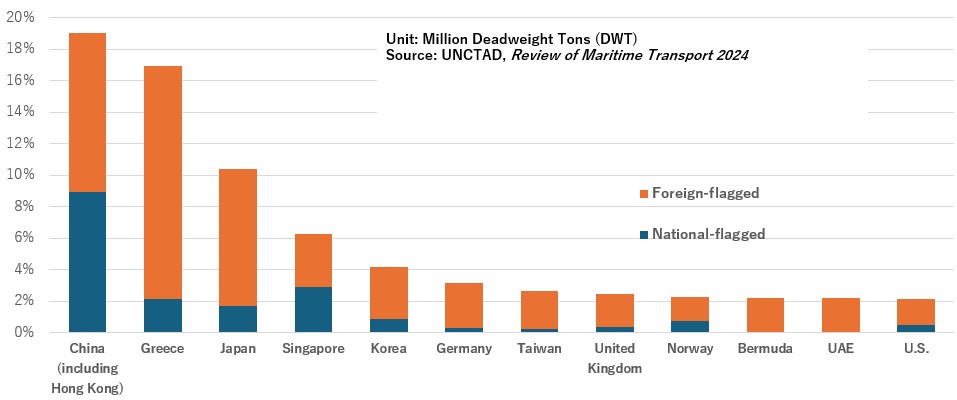
Share of Global Controlled Fleet Tonnage by Country
Source: UNCTAD, Review of Maritime Transport 2024
By vessel type, the United States maintains a certain presence in tanker shipping and some segments of the bulk carrier market. This is largely because the country is home to many major commodity companies — including energy, mining, and grain corporations — that operate their own transportation divisions and own or manage fleets to serve their business needs.
In sectors without this kind of in-house transportation demand, however, the U.S. presence in international shipping has almost disappeared. Container shipping is a prominent example. SeaLand and APL, two American companies that once led the containerization revolution, were eventually acquired by foreign shipping groups. SeaLand became part of Maersk of Denmark, while APL is now part of CMA CGM of France.
Even today, the U.S. government requires a certain percentage of government cargo, including military supplies, to be transported on U.S.-flagged vessels for national security reasons. As a result, foreign shipping companies such as Maersk and CMA CGM register some vessels under the U.S. flag and use them to carry military and government-related cargo.
Compared with its international shipping sector, the United States has maintained a relatively substantial domestic maritime transportation industry. This is largely due to the country's vast geography and the need to serve non-contiguous states and territories such as Hawaii and Puerto Rico, which require long-distance maritime transport supported by vessels of considerable size.
Matson, one of the leading domestic container carriers in the United States, operates primarily on routes linking the U.S. mainland with Hawaii, while also serving Alaska, Guam, and Micronesia. Although the company operates a limited number of international services, including shuttle routes between the United States and China, such activities account for only a small portion of its business. These domestic routes are nevertheless long-haul services, and while Matson's fleet is smaller than those of the world's leading container carriers operating major east-west trade lanes, it consistently ranks relatively high within the broader container shipping industry, typically around 30th in global rankings.
Supporting this domestic maritime sector is the Jones Act, a cabotage law enacted in 1920. The Act limits transportation between U.S. ports to vessels that are U.S.-flagged, owned by U.S. interests, crewed by U.S. mariners, and built in U.S. shipyards. While many countries maintain cabotage protections, few major maritime nations require domestic vessels to be built domestically.
Although the Jones Act has helped protect the U.S. shipbuilding industry, it has also contributed to rising construction costs and technological stagnation.
Today, vessels built in U.S. shipyards are significantly more expensive than those constructed on the international market, and delivery times have become increasingly lengthy. Moreover, the country has largely lost the capability to build technologically advanced commercial vessels such as LNG carriers. In some cases, Jones Act restrictions have even complicated LNG transportation from the U.S. mainland to Hawaii and Puerto Rico, creating situations where imports from foreign suppliers become the more practical option.
To better understand the current state of the U.S. maritime industry, it is useful to examine how it evolved over time.
In the early 20th century, the United Kingdom dominated global shipping, controlling roughly half of the world's merchant fleet. At that time, the United States was one maritime nation among many. Two world wars, however, dramatically transformed that landscape.
During World War I, Europe became the center of conflict and increasingly depended on imports from the United States and Asia. At the same time, many European merchant vessels were requisitioned for military use. As trade demand increased while vessel availability shrank, a historic global shipping boom emerged. Possessing a strong industrial base, the United States rapidly expanded ship construction and rose to become the world's second-largest maritime nation. (Japan ranked third at the time.)
World War II accelerated this transformation. As the conflict expanded across the globe, demand for cargo transportation surged. Merchant ships became major targets of attack, and vast numbers of prewar vessels were lost. The United States responded by becoming the world's principal shipbuilder.
As discussed in our previous article, Getting to Know Bulk Carriers — The Basics and Their History, the United States mass-produced the well-known Liberty Ships, standardized cargo vessels designed for wartime deployment. Incorporating advanced techniques of the era, including modular construction and welded assembly, these ships were built at an extraordinary pace across 18 shipyards. At peak production, more than one vessel per day was reportedly completed. These ships became the foundation of postwar American shipping, helping the United States emerge as the world's largest maritime power.
After the war, as Japan and Europe rebuilt their economies, the United States again led the industry through the containerization revolution. American carriers, particularly SeaLand, founded by Malcolm McLean, pioneered innovations that fundamentally transformed global maritime transportation.
The 1970s brought a major structural change to the shipping industry. New business models emerged in which shipowners registered vessels under so-called flags of convenience in countries such as Panama, Malta, and the Marshall Islands, where taxes and regulatory costs were lower. These vessels were often operated with crews from developing countries, enabling significantly lower operating costs.
By around 1980, these lower-cost fleets began competing directly with ships registered in traditional maritime nations, forcing many established shipping countries to reconsider their strategies. The paths they chose would shape the industry for decades to come.
European countries, anticipating greater integration through the European Union, adopted a cooperative approach. Different nations specialized in areas such as ship ownership, vessel operation, and maritime services, creating a maritime ecosystem that allowed Europe as a whole to maintain and strengthen its position in global shipping.
Japan pursued a different course. Following the rapid appreciation of the yen after the 1985 Plaza Accord, the country undertook far-reaching structural reforms. With support from industries dependent on long-term transportation contracts, Japan restructured its maritime sector independently and preserved its international competitiveness.
The United States, by contrast, did not pursue comparable reforms. International carriers such as SeaLand and APL were eventually acquired by foreign competitors, contributing to the decline outlined earlier.
One reason for this outcome was that domestic shipping and shipbuilding had become deeply intertwined under a heavily protected, high-cost structure. Furthermore, U.S. domestic shipping often resembled international shipping more closely than domestic shipping did in Europe or Japan. Domestic trades often relied on long-distance routes and large vessels comparable to those used internationally. As a result, pursuing painful reforms solely within the international shipping sector proved politically and economically difficult.
A second factor was the post-Cold War expansion of free trade. Foreign carriers competed intensely in the U.S. market, improving services and reducing costs. As long as cargo moved efficiently, the absence of major U.S.-owned international shipping companies attracted relatively little political attention. Maintaining a globally competitive international shipping industry was therefore not widely viewed as a national priority.
Why, then, is maritime transportation attracting renewed attention in the United States today? Broadly speaking, there are two key reasons.
The first is a changing view of free trade. For decades, many Americans believed that free trade generated wealth for the United States. Today, growing numbers question whether free trade has instead transferred wealth overseas. The sharp rise in container freight rates during the COVID-19 pandemic, together with broader geopolitical tensions, has fueled public skepticism. As a result, the fact that international shipping serving the United States is largely carried by foreign shipping companies has increasingly become a political issue.
The second reason is China's rapid rise. Historically, global shipping and shipbuilding were led by countries such as Japan, European nations, and South Korea — all close U.S. partners. In recent years, however, China has dramatically expanded its presence. In terms of controlled fleet ownership, China surpassed Greece in 2022 to become the world’s largest shipowning nation by controlled fleet tonnage, and now accounts for nearly 20 percent of the global fleet. China's position in shipbuilding is even more striking. In 2024, Chinese shipyards secured 77 percent of global newbuilding orders.
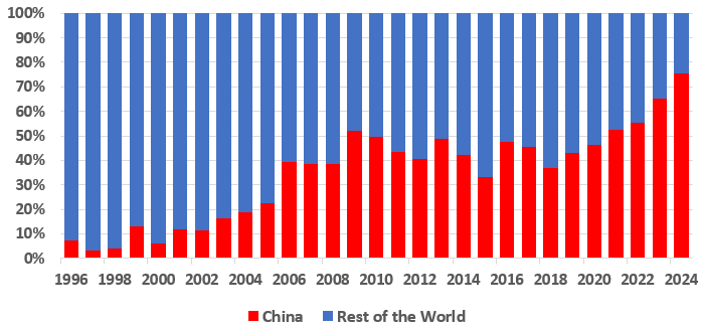
China’s Share of Global Newbuilding Orders
Source: Clarksons Shipping Intelligence Network
At present, China does not appear to be directly challenging the existing international maritime order. Nevertheless, as U.S.-controlled fleet capacity has declined, China's growing influence has increasingly been viewed in Washington through the lens of national security.
These two developments have fueled a growing debate within the United States over how the nation's shipping and shipbuilding industries should be protected and strengthened. Yet the discussion remains fragmented.
Even within the broad framework of what is often described as “America First” thinking, several distinct perspectives coexist. Some argue for protecting shipping and shipbuilding as domestic industries. Others emphasize the need to compete with China across the full spectrum of maritime power, including international shipping capabilities. Still others focus on preventing foreign shipping companies from capturing economic value generated in the U.S. market.
Complicating matters further is the fact that the international shipping industry, which would ordinarily serve as a key stakeholder in such debates, has largely disappeared as an American-owned sector. This absence makes policy discussions surrounding maritime affairs unusually complex.
This article has examined the relatively small scale of today’s U.S. shipping industry and the historical process through which what was once the world’s largest merchant fleet declined. It has also explored why maritime issues have reemerged as a topic of national debate in the United States.
As noted at the outset, a wide range of policy measures is currently under discussion amid this renewed interest in maritime affairs. Many proposals remain at an early stage, and their ultimate direction is still uncertain. As the debate develops and specific policies begin to take shape, we hope to provide further analysis and explanation in future articles.