What is NYK?The World of Vessels


When you choose the dark mode display, you can reduce the power consumption and CO2 emissions generated by the website's screen display.
Released : May 27, 2026
Updated : Jun. 23, 2026


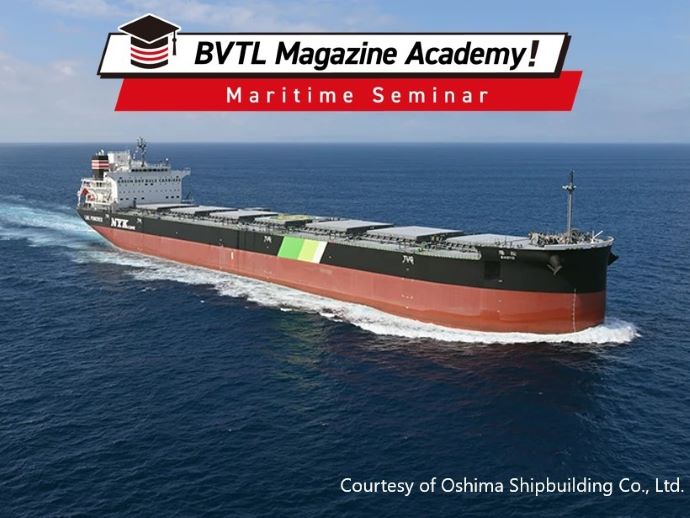

Despite their simple structure, bulk carriers play a vital role in supporting Japan’s economy and global trade. Understanding their types and history will change the way you read the news.
Currently, I oversee research across the entire shipping and logistics business. However, the first area I worked on as a shipping analyst was the business environment of bulk carriers. My doctoral dissertation also focused on market fluctuations in the bulk carrier sector. Even today, topics related to bulk carriers remain the most personally engaging for me.
That said, bulk carriers are not widely recognized by the general public. For example, images and footage used in news coverage on trade often feature container ships or car carriers. Yet, when Japan’s imports are categorized by vessel type in terms of weight, bulk cargo transported by bulk carriers accounts for about half of the total. Were you aware of this?
With that in mind, I will be writing a series of articles on this topic to help readers better understand bulk carriers. Since the subject cannot be covered in a single article, this first installment focuses on the basics of bulk carriers and their history.
A bulk carrier is a ship designed specifically to transport bulk cargo. Bulk cargo refers to unpackaged granular or powdered solid materials loaded directly into a ship’s holds. Typical examples include iron ore, coal, grain, cement, and chemical products.
In the shipping industry, these cargoes are commonly classified into two categories: major bulk (iron ore, coal, and grain) and minor bulk (all other bulk commodities) — a practical, if somewhat inelegant, naming convention.
To efficiently handle unpackaged, free-flowing cargo, bulk carriers are constructed with large internal compartments known as cargo holds, into which cargo is loaded using cranes or conveyor systems. The deck is equipped with hatches for loading and unloading, each sealed with a hatch cover. Structurally, a bulk carrier is remarkably straightforward — essentially a watertight hull with partitioned holds, hatch lids, and propulsion.
As noted above, bulk cargo encompasses many commodities, each with different trade routes, port infrastructure, and typical shipment volumes. These factors place practical limits on vessel dimensions. As a result, most bulk carriers today are designed around standardized classes that optimize capacity within the constraints of major cargoes.
The four widely recognized standard classes of oceangoing bulk carriers are Capesize, Panamax, Handymax, and Handysize. Capesize carriers primarily transport iron ore, while Panamax carriers mainly handle coal and grain. Since these two vessel types rely on shore-based cranes and belt conveyors for cargo loading and unloading, they are not equipped with their own cargo-handling gear. Handymax and Handysize vessels, on the other hand, call at smaller ports that lack such shore facilities and are therefore fitted with onboard cranes. The primary cargo for Handymax is grain and minor bulk commodities, while Handysize mainly carries minor bulk.
Please refer to the illustration below for the standard sizes of these four vessel types.
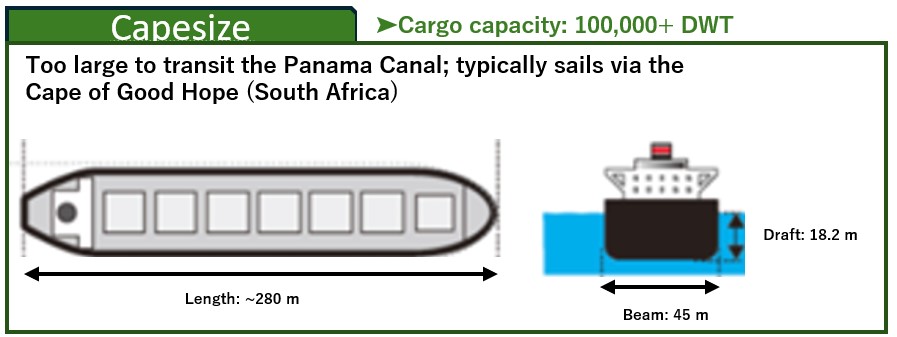
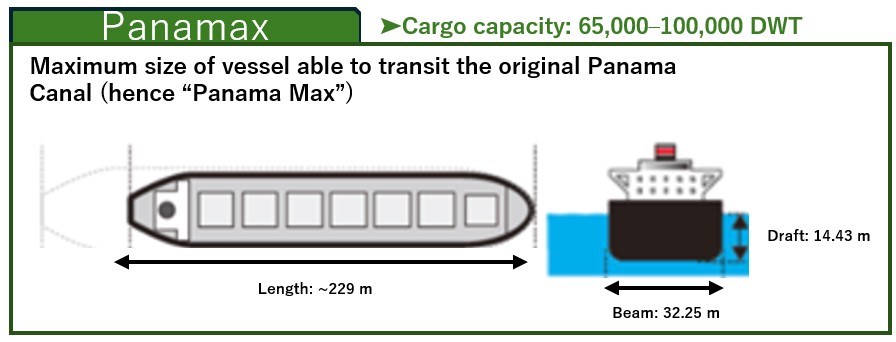
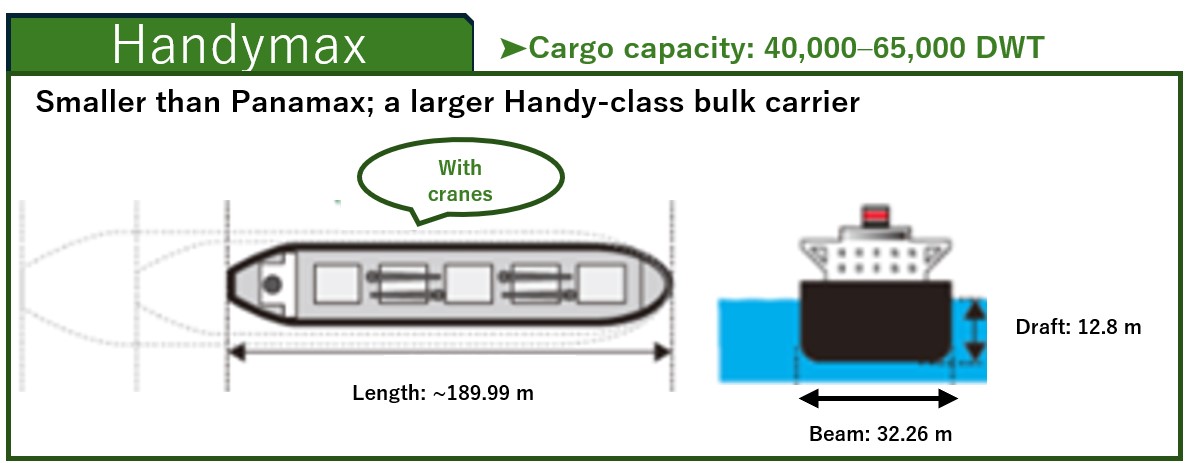
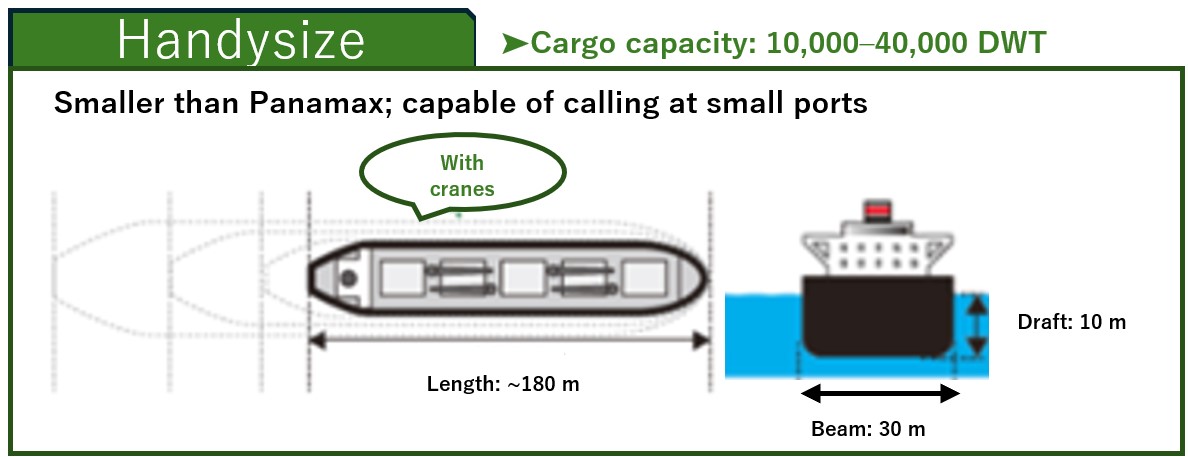
Size and structure of the four standard bulk carrier types
Bulk carriers have a very simple structure, and the cargoes they transport — such as ore and grain — have existed since ancient times. One might therefore assume that bulk carriers have a long history. However, this is not the case.
Bulk carriers only began to be widely used as oceangoing cargo vessels in the 1950s. In other words, they have a history of less than 100 years, roughly the same as container ships, which are often perceived as modern.
The reason this vessel type did not emerge earlier lies on the cargo side. For a vessel dedicated to bulk cargo to be economically viable, it needs to operate at full capacity throughout the year. Ports must also have cargo-handling and storage facilities capable of handling such large volumes. These conditions were not met until recently. For a long time, bulk cargo accounted for only a small share of global trade, and its volume fluctuated significantly with the seasons.
Before bulk carriers appeared, bulk cargo was transported by conventional general cargo ships (ships with multiple decks inside the holds). Cargo was either packaged, or temporary containers were installed in the holds using plywood. Although labor-intensive and time-consuming, this approach was still more cost-effective than building specialized ships at the time.
Bulk carriers began to take shape in the 1950s, driven by two key developments.
First, demand for bulk cargo transportation increased in advanced economies such as Japan, the United States, and Europe. In Japan, large industrial complexes were established along coastal areas during the period of rapid economic growth, leading to the import of large volumes of raw materials such as iron ore, which is less affected by seasonality.
Second, the retirement of Liberty ships — standard cargo ships built during World War II that formed the backbone of the global merchant fleet — began around the same time.
Liberty ships were mass-produced by the United States for wartime transport and were later sold to the private sector at very low prices, becoming central to global shipping after the war. Some of their replacements were designed specifically for bulk cargo transportation.
Port infrastructure around the world had been developed to accommodate the size of Liberty ships, which meant that vessels of similar size could call at most ports, ensuring versatility. This size standard remains influential for conventional cargo ships even today. However, bulk carriers soon began to grow larger.
Because bulk carriers were designed exclusively for bulk cargo, they significantly reduced loading and unloading time and labor. This increased the economic advantage of larger vessel sizes compared to the era of conventional cargo ships.
As different bulk cargoes have different constraints, vessel sizes expanded accordingly. By the 1980s, the standard vessel types seen today had largely been established.
In the 21st century, China’s rapid economic growth — driven by large-scale consumption of mineral resources — accelerated the expansion of global bulk cargo trade. While global trade volumes of bulk cargo and tanker cargo were roughly equal in 1984, by 2024, bulk cargo trade had grown to about twice the volume of tanker cargo.
In this article, we introduced bulk carriers, outlined the major categories of bulk cargo and the four standard vessel types, and highlighted that, despite their relatively simple structure, bulk carriers have a history of only about 70 years as oceangoing cargo vessels.
We hope this article helps you form a clearer image of bulk carriers when you encounter them in the news. In future installments, we will continue exploring the world of bulk carriers, including market topics such as freight rates and charter rates, as well as environmental regulations. Stay tuned.