What is NYK?The World of Vessels


When you choose the dark mode display, you can reduce the power consumption and CO2 emissions generated by the website's screen display.
Released : Jun. 23, 2026
Updated : Jun. 23, 2026


If you are reading this, you likely have at least some interest in shipping or trade. In fact, maritime transport is the main driver of global trade. By examining modal share and cargo composition, we can clearly see — from data alone — the overwhelming presence of shipping in international trade.
Have you ever asked this simple question? In Japan’s case, the answer is astonishing: 99.5% of trade (by tonnage) is carried by maritime transport.
Yet, despite shipping’s importance, information on global shipping is surprisingly hard to find. Here, we examine maritime transport’s role in international trade using available statistics. Since sources and publication years differ, we will focus on ratios rather than absolute volumes.
Let us first compare transport modes in international trade. As an island nation, Japan relies mainly on sea and air. In contrast, countries with land borders also trade via trucks and rail. Here, we compare the shares of these four transport modes.
There are several methods to measure modal share: weight (tons), transport work (weight × distance = ton-kilometers), and value (U.S. dollars). In this article, we use transport work (ton-kilometers) to compare transport capacity by mode. The chart below is based on data from the International Transport Forum (ITF), an OECD-affiliated organization.
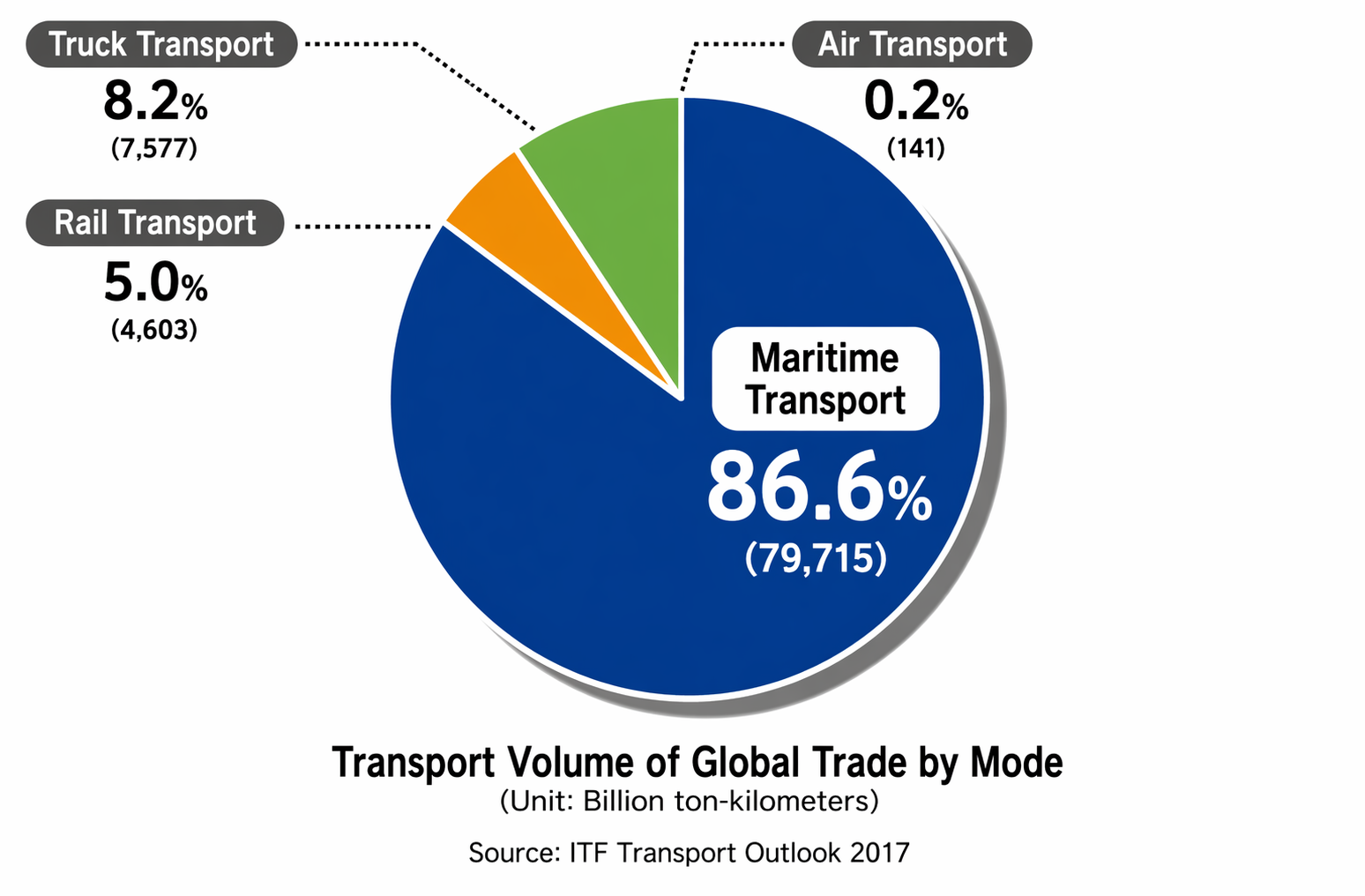
As the data shows, maritime transport dominates with a share of 86.6%. Even when combined, rail and truck transport account for less than one-sixth of maritime transport. This is because trade by truck and rail is mostly regional and over relatively shorter distances, resulting in lower transport volumes.
Air transport accounts for only 0.2%. Since weight has a significant impact on this metric, air transport appears very small compared to other modes. However, air cargo typically consists of high-value-added goods with a high price per unit weight, making its presence more significant when measured in monetary terms.
Next, let us examine maritime transport volume by cargo type. Seaborne trade is commonly categorized by vessel type.
The following breakdown is based on data published by Clarkson, a leading global maritime information company.
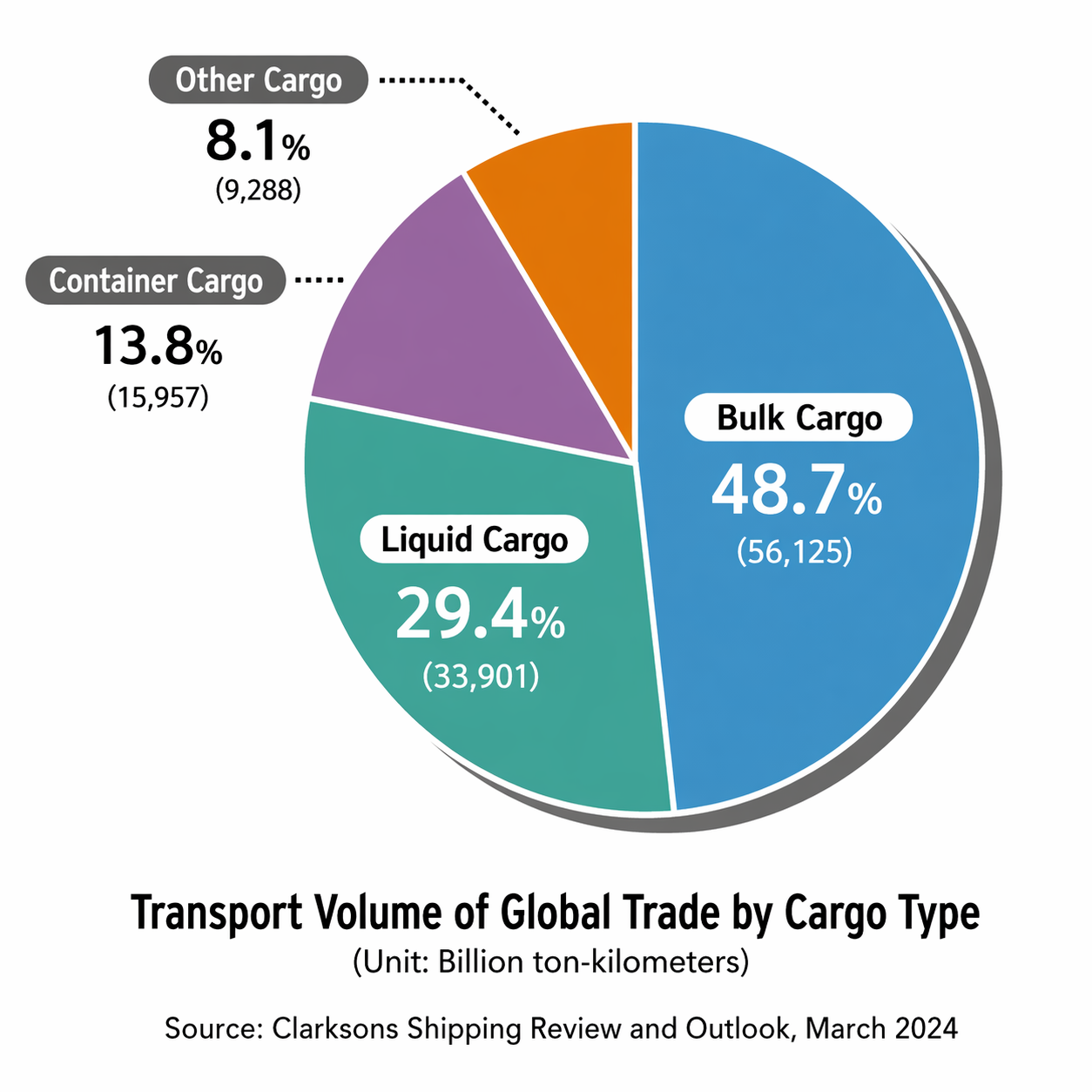
As shown, bulk cargo accounts for 48.7%, nearly half of all seaborne volume. When liquid cargo is included, the combined share reaches approximately 80%, indicating that resource-related commodities make up the majority of maritime transport.
By contrast, goods commonly associated with supply chains — such as consumer products and industrial components — account for just over 20% of the total seaborne volume.
Finally, let us look at the fleet that carries this cargo.
Since this is a measure of transport capacity, it is best expressed not by the number of vessels but by deadweight tonnage (DWT). DWT represents the weight of cargo a vessel can carry, rather than the weight of the vessel itself. In the shipping industry, the term “tonnage” typically refers to DWT.
The principal vessel categories are bulk carriers, tankers, container ships, and other cargo vessels.
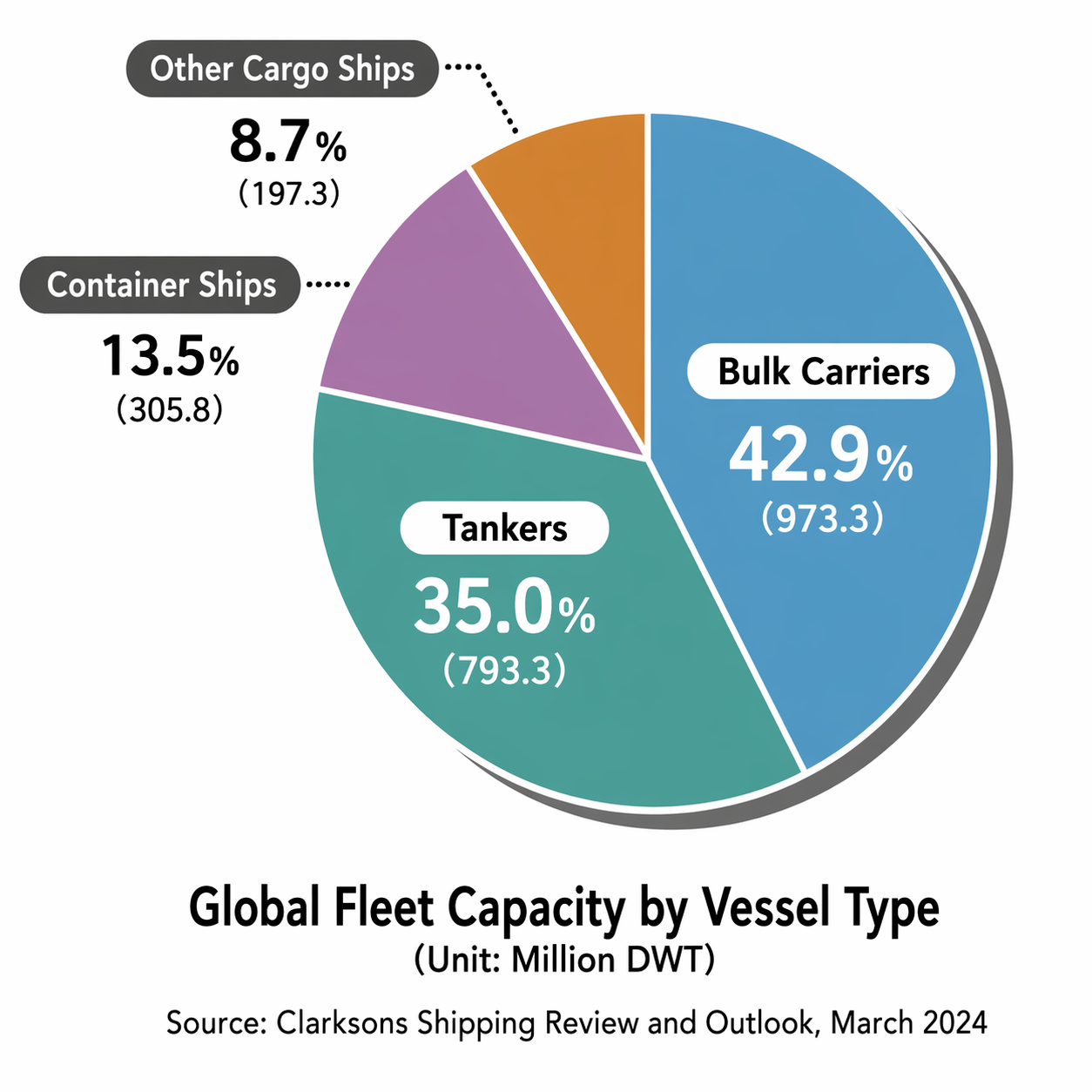
The total global cargo fleet amounts to 2.27 billion DWT, with bulk carriers accounting for just over 40%, followed by tankers and then container ships. This distribution generally mirrors the cargo-type composition of seaborne trade, with a slightly smaller share for bulk carriers and a slightly larger share for tankers.
The data makes one point unmistakably clear: maritime transport is the foundation of global trade. It carries 86.6% of global trade volume, and the majority of that consists of resource-related cargo.
These facts may offer a fresh perspective even for those who are regularly involved in trade and logistics. In future articles, we will examine country-specific shares as well as trends over time.
Note: This article is a partially edited reprint of a piece originally published by NewsPicks, a leading Japanese business and economic media platform.