What is NYK?The World of Vessels


When you choose the dark mode display, you can reduce the power consumption and CO2 emissions generated by the website's screen display.
Released : Feb. 10, 2026
Updated : Feb. 13, 2026


What is a gantry crane? Even if you don’t recognize the term, you’ve likely seen one at port.
With its robust steel legs and towering crane structure, its silhouette resembles a giraffe — hence the nickname.
Typically, gantry cranes are installed on quaysides to load and discharge cargo. But what happens when a port lacks cranes, or existing cranes are fully booked? Such delays could disrupt carefully planned schedules. That’s why some vessels are equipped with their own cranes — these are gantry crane vessels.
Now, let’s focus on the first part of the name: “Open Hatch.”
This vessel type is also known as an open hatch bulker. Unlike tankers or specialized ships for containers or cars, bulk carriers transport a wide range of cargo — metals, timber, grain, fertilizer — in multiple cargo holds.
Conventional bulk carriers have narrow hatch openings, and the interior — including the floor and ceiling corners — is sloped, making loading and unloading somewhat inconvenient. Open hatch bulkers feature box-shaped holds with large openings across the entire deck, enabling efficient cargo handling.
Combine this design with onboard gantry cranes, and you have the highly versatile open hatch gantry crane (OHGC) vessel.
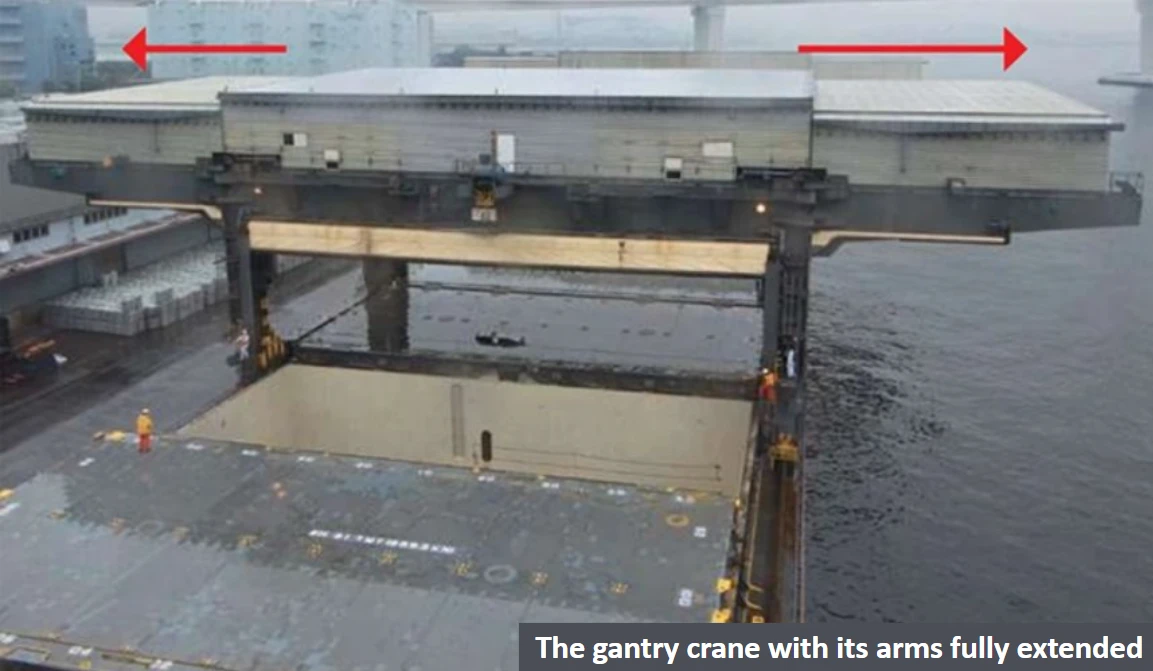
The gantry crane with its arms fully extended — a hallmark of efficient cargo handling.
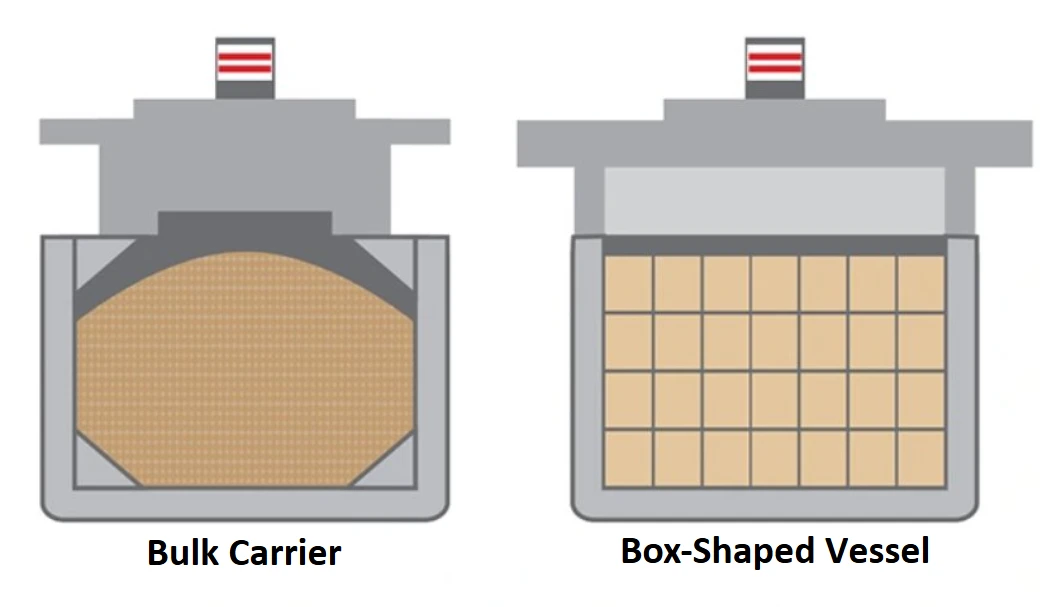
Compared to conventional bulk carriers, box-shaped vessels allow cargo to be stowed seamlessly into every corner of the hold.
The NYK Group currently operates 32 open-hatch gantry crane vessels (pictured: Saga Fjord).
Let’s take a look at the structure of an OHGC from the deck.
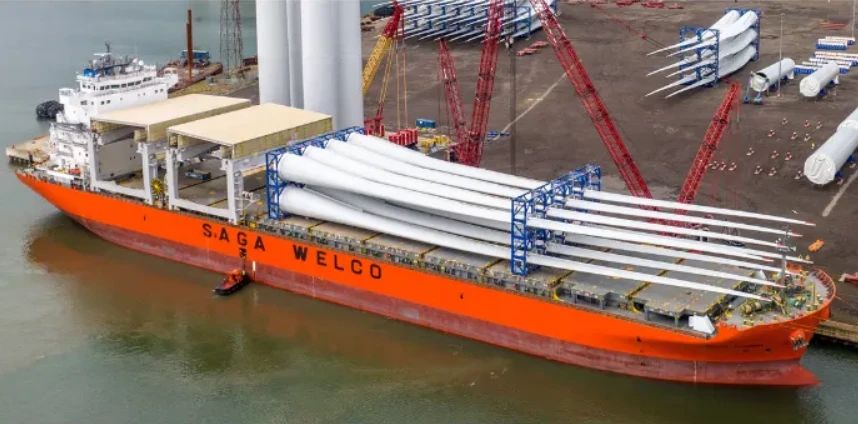
The deck is flat and spacious. This area consists of hatch covers — the lids for the cargo holds. When closed, the deck can accommodate large cargo such as containers or wind turbine blades.
Two gantry cranes, shaped like gates or bridges, are installed on the deck. Unlike quay gantry cranes, these do not have the long “neck” that resembles a giraffe. The term “gantry” refers to a gate-like structure with beams supported by multiple legs. Beneath the beam, a suspended frame moves laterally to handle cargo.
The gantry cranes are self-propelled. During cargo operations, they travel fore and aft along rails, stopping above the designated hold. Unlike jib cranes fixed to a single leg, gantry cranes move in straight lines, eliminating wasted motion and enabling stable, efficient, and rapid cargo handling.
How is cargo brought aboard from the quay?
Arms extend from both sides of the gantry beam toward the shore. Suspended frames move along these arms to pick up cargo. On Saga Fjord, the beam spans 32.26 meters and boasts a lifting capacity of about 42 tons. The arms are equipped with roofs and retractable side curtains, minimizing water damage to cargo during rain.
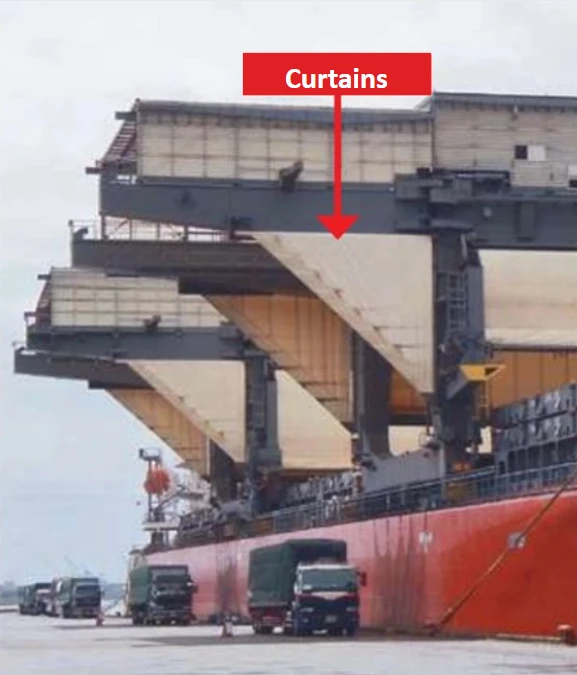
Side curtains installed on the gantry crane.
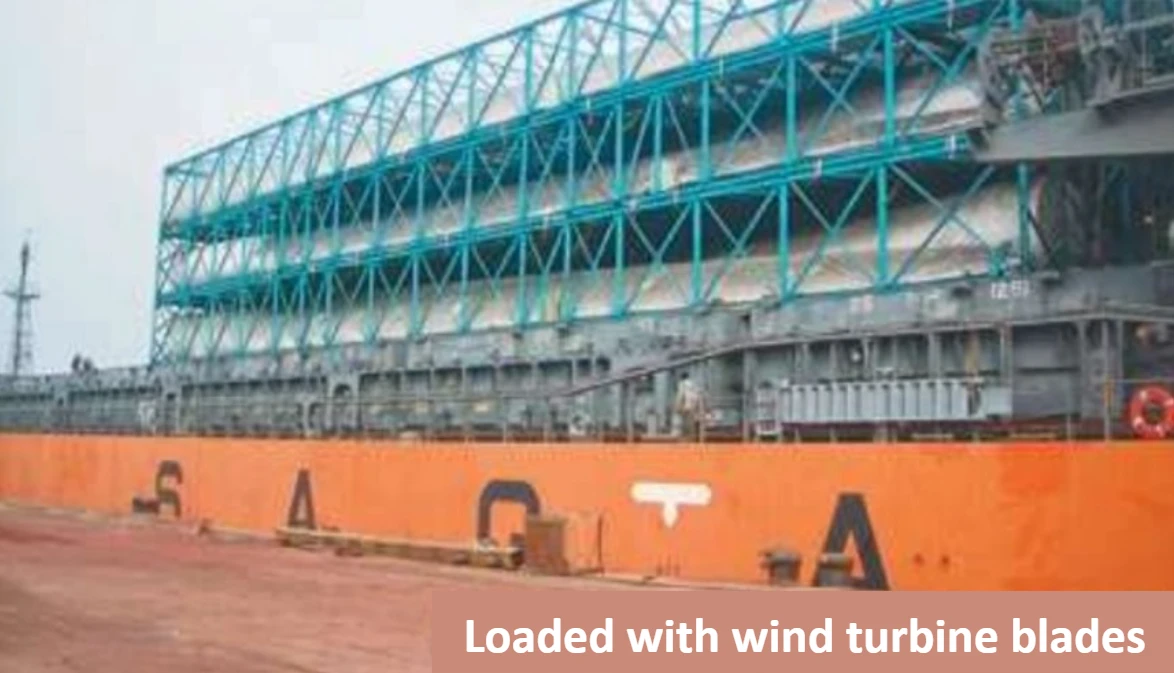
The flat deck makes it ideal for handling oversized cargo such as wind turbine blades.
How is cargo loaded and discharged into the holds?
The suspended frames of the gantry cranes are interchangeable depending on type of cargo.
For pulp or aluminum ingots, a multi-purpose frame with multiple hooks ensures stability. Hooks can be released from the operator’s cabin. Vacuum clamps with large suction pads are used for rolls of paper. For granular or powdered cargo such as grain or cement, a bucket frame is employed. Containers stowed on deck require a container-specific frame.
While conventional bulk carriers typically have four–seven holds, NYK’s OHGC features 10 holds as standard. Smaller capacity holds allow multiple cargo types to be transported simultaneously.
Careful planning is essential to determine how much cargo to load into each hold. Cargo weight varies by type, and improper distribution can affect vessel stability during navigation.
Light cargo can fill all holds completely. For heavy cargo, alternate holds may be left empty, or loads may be staggered to prevent lowering the center of gravity, which could increase rolling during the voyage.
Managing cargo during the voyage is also essential. Some cargo is sensitive to humidity. For example, when loading cargo in hot and humid regions such as Brazil and then sailing to cooler areas, condensation can form inside the holds, reducing cargo quality. To prevent this, all holds on open-hatch gantry crane vessels are equipped with dehumidifiers. In addition, for cargo other than granular or powdered materials, reinforced rubber airbag spacers are inserted into gaps during loading to prevent cargo shifting and collisions between items.
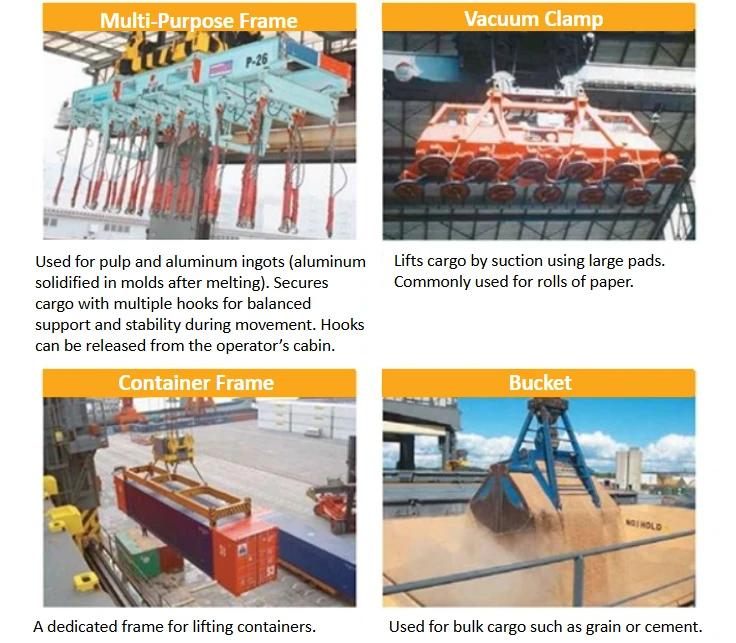
Multi-purpose frame, Vacuum clamp,
Container frame, Bucket
NYK’s OHGC primarily transports pulp from South America, a region ideal for eucalyptus cultivation and among the world’s leaders in pulp production, thanks to its high output and cost competitiveness. These vessels deliver pulp to Asia and Europe, loading and discharging other cargo along the way before returning to South America — a truly global operation.
At ports in South America, aluminum ingots, steel products, and timber are loaded for onward transport. The pulp delivery schedule, however, must always be strictly maintained. Onboard gantry cranes play a vital role in ensuring efficient loading and unloading at intermediate ports.
OHGC combines flexibility for pulp and diverse cargo, enabling them to operate worldwide. You may rarely see these vessels in Japan, but if you do, give them a big cheer!
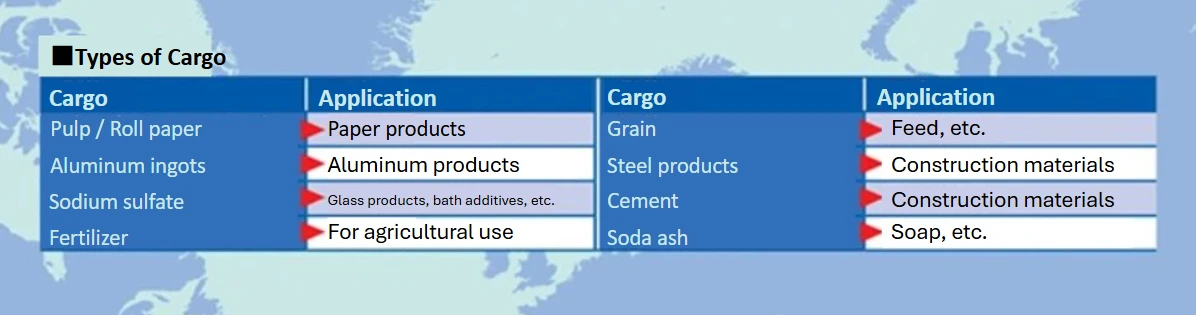
Types of Cargo Loaded
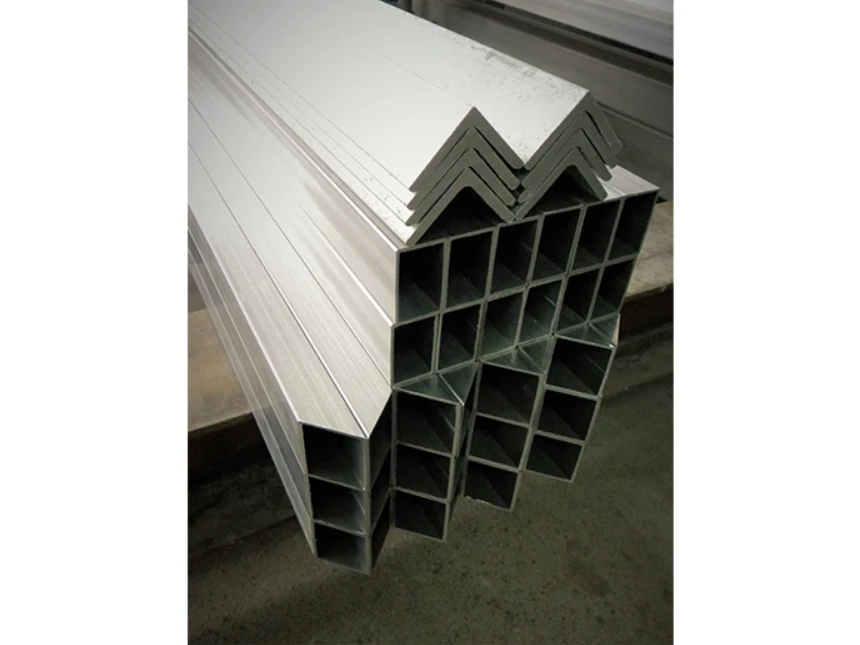
Image of steel products being loaded
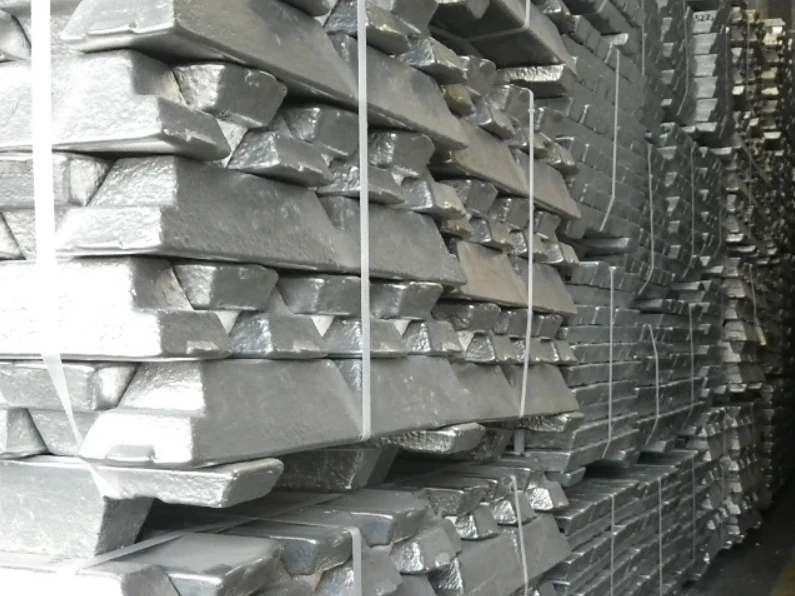
Image of aluminum ingots being loaded