Behind the Scenes at NYKStaff Voices

When you choose the dark mode display, you can reduce the power consumption and CO2 emissions generated by the website's screen display.
Released : Jun. 04, 2026
Updated : Jun. 04, 2026


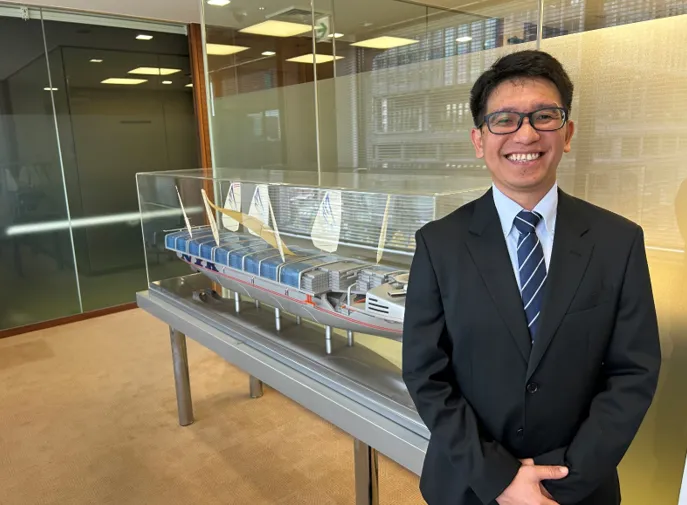
Captain Daniel Tarifa Capiral serves as a marine superintendent in the Safety and Quality Team of NYK’s Dry Bulk Marine Quality Control Group. A graduate of the Maritime Academy of Asia and the Pacific (MAAP) in the Philippines, he joined the NYK Group in 2004 through the International Mariners Management Association of Japan (IMMAJ) and has since built a career as both a seafarer and an educator.
Over the years, he has gained extensive experience across various vessel types, including LPG, LNG, and bulk carriers. After being promoted to master, he took on responsibilities in training and safety quality management, drawing upon his firsthand experience at sea.
Based at NYK’s headquarters in Tokyo, Captain Capiral conducts safety dialogues with shipowners, inspects vessels, and promotes NYK’s proprietary safety standard, NAV9000 Plus. We spoke with him about his journey and his commitment to fostering a safety culture.
Captain Capiral did not initially envision a career at sea. As a student, he was more interested in business-related fields such as accounting and banking. His path changed when he discovered MAAP.
“The full scholarship support and MAAP’s structured pathway from cadet to officer strongly appealed to me. I had no seafarers in my family, but the disciplined environment and the idea of life at sea felt new and exciting.”
Training at MAAP was rigorous and often described as military-style. Cadets were required to stay on campus for a full year without returning home and were expected to meet high standards in academics, discipline, and physical fitness.
“Out of 150 students who enrolled, only 127 graduated. That experience instilled a deep sense of responsibility and discipline — values that became the foundation of my approach to life at sea and safety.”
After joining NYK Group through IMMAJ in 2004, he has built and continued his career with the company ever since.
Captain Capiral began his seagoing career aboard a containership before broadening his experience to gas carriers, including LPG and LNG vessels, as well as bulk carriers. In the bulk sector, he has served across a wide spectrum of vessel types, including VLOCs, Capesize bulk carriers, Panamax bulkers, and wood-chip carriers.
“This diverse onboard experience directly supports my current work in dry bulk quality management.”
A distinctive aspect of his professional journey is the way he combined onboard experience with maritime education. During leave periods, he taught maritime subjects at NYK Group-affiliated training facilities and maritime academies, sharing practical insights with students.
“I would spend six months at sea, then three to six months teaching ashore. That cycle allowed me to bring real-life experience into the classroom while also understanding trainees' perspectives. This rotation between onboard experience and maritime education strengthened my systematic approach to safety, and continues to be a major asset in my current role.”

At NYK headquarters, Captain Capiral is responsible for improving vessel quality, monitoring crew performance, and conducting safety dialogues with shipowners and management companies. He visits vessels calling at Japanese ports and, when necessary, assesses safety conditions remotely.
His responsibilities extend beyond Japanese shipowners to include international partners, requiring close communication across cultures.
“Many dry bulk vessels are crewed by Filipino seafarers. Being able to communicate in our native language allows me to understand their honest concerns. This helps not only with safety matters but also with addressing issues related to daily life and welfare, which in turn contributes to improving morale.”
He sees his role as going beyond technical responsibilities.
“Serving as a bridge between cultures is an important part of my role at NYK headquarters.”
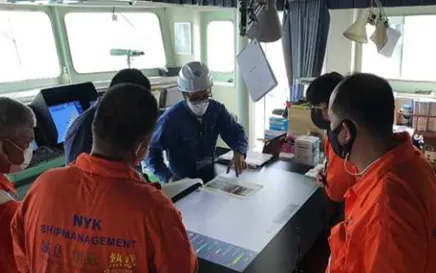
Visiting vessels and maintaining close communication with crew members is a key part of his role at NYK headquarters.
In 1998, NYK introduced its proprietary safety standard, NAV9000. The framework aligns with international standards and has obtained ISO 9001:2015 certification from ClassNK, an independent third-party ship classification society. In 2026, NYK comprehensively upgraded the framework as NAV9000 Plus.
With a renewed focus on “guidance” and “co-creation,” NAV9000 Plus seeks to further enhance safety quality across operated vessels through continuous, collaborative improvement.
“NAV9000 Plus is not merely an inspection system. It represents a safety partnership through which NYK shares its accumulated safety culture and best practices with shipowners.”
At the start of new contracts, shipowners sign a memorandum confirming alignment with NYK’s safety expectations. This is followed by company audits, vessel inspections, and ongoing improvement proposals based on accumulated operational data.
“What matters is not simply pointing out deficiencies but building a safety culture based on mutual trust. That continuous effort is what prevents accidents.”
Captain Capiral believes the core of maritime safety is what he calls the “safety mind.”
“Skills alone are not enough. What matters is a sense of responsibility to uphold safety even when no one is watching — anticipating risks and acting with discipline and integrity. These are essential in international shipping.”
He emphasizes that time should be spent on preventing incidents rather than responding to them, and that trust-based relationships with shipowners and management companies form the foundation of safe operations.
“From cadet to captain to my current role at headquarters, NYK has given me many valuable opportunities to develop my ‘safety mind.’ I hope this passion for safety will be passed on to the next generation, helping to build a stronger maritime community.”
Even as technological innovation continues to advance, people remain at the heart of safety. Captain Capiral’s journey — from onboard experience to maritime education to headquarters leadership — demonstrates the enduring importance of human connections in sustaining a safety culture.
*Captain Capiral’s affiliation and location are as of the time of the interview conducted in November 2025.