
May 14, 2026
NYK Conducts First Onboard Measurement in Demonstration Test of Methane Oxidation Catalyst System for LNG-Fueled Marine Engines
Aiming to Significantly Reduce Methane Emissions
NYK has conducted its first onboard measurement in a demonstration test of a methane oxidation1 catalyst system for marine engines fueled by liquefied natural gas (LNG).
This demonstration test is being carried out in collaboration with Mitsubishi Heavy Industries Marine Machinery & Equipment Co., Ltd. (MHI-MME), Mitsubishi Shipbuilding Co., Ltd. (MHIMSB), and DAIHATSU INFINEARTH MFG.CO.,LTD. (IE).
The catalyst system has been installed on the LNG bunkering vessel2 KEYS Azalea, which supplies LNG fuel to LNG-fueled ships. The vessel is owned by KEYS Bunkering West Japan Co., Ltd.3 and managed by Taiheiyo Enkai Kisen Co., Ltd., an NYK Group company.
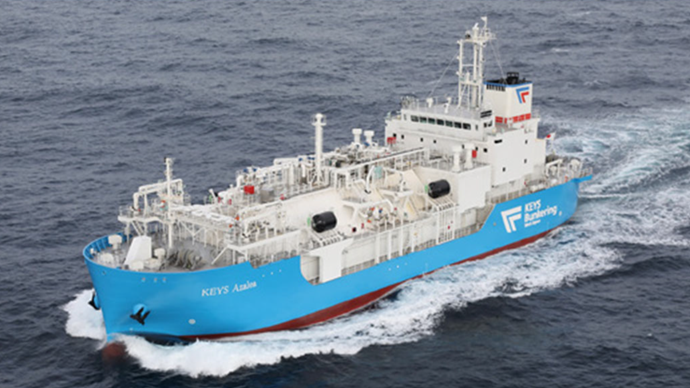
LNG bunkering vessel KEYS Azalea
In LNG-fueled marine engines, “methane slip” can occur when some of the methane in the fuel does not burn completely and escapes into the atmosphere. Because methane has a higher global warming potential than carbon dioxide, reducing methane slip is an important technical challenge for decarbonizing maritime transport. The methane oxidation catalyst system reduces these emissions by oxidizing methane in the exhaust gas produced by LNG-fueled engines.
This catalyst system was developed by integrating each partner’s specialized technological expertise: MHI-MME’s design and manufacturing of catalyst systems, MHIMSB’s shipbuilding, and IE’s engine optimization.
In prior tests on land-based engines, the system demonstrated an initial methane oxidation rate4 of at least 70% (i.e., at least 70% methane removal). In the latest onboard measurement during this demonstration, the system achieved over 90% methane oxidation as a standalone exhaust treatment unit.
As part of this demonstration, a full-scale prototype has been installed aboard KEYS Azalea for a one-year trial period. Operating mainly in the Kyushu and Seto Inland Sea regions, the vessel is now undergoing performance verification under actual operating conditions to support practical application.
The NYK Group is actively promoting the use of next-generation fuels, including LNG, to achieve decarbonization in maritime transport. We will continue working to reduce greenhouse gas emissions from vessels and minimize environmental impact.
1 Methane oxidation: A chemical reaction in which methane (CH₄) reacts with oxygen (O₂) to form carbon dioxide (CO₂) and water (H₂O).
2 LNG bunkering vessel: A small vessel that supplies LNG fuel to ships fueled by LNG.
3 KEYS Bunkering West Japan Ltd.
Headquarters: Kitakyushu City, Fukuoka Prefecture, Japan
Representative: Kenichi Kawamoto
Details of business: Sales of LNG fuel; owner of LNG bunkering vessel
Stockholders: Kyushu Electric Power Co., Inc. 40%; NYK Line 40%; Itochu ENEX CO., LTD. 15%; Saibu Gas Co., Ltd. 5%
4 Methane oxidation rate: The percentage of methane oxidized within the catalyst system, calculated by comparing the methane concentration (ppm) in the exhaust gas at the inlet of the system with that at the outlet after treatment.


The news on this website is as of the date announced and may change without notice.